By Ryan Griffeth
This article is the opinion of Optimus Futures.
Getting the best price for a hedge is one of the first questions a new producer asks. To be blunt, that’s usually the wrong question.
A better question is: how do I get a hedge order execution that fits my operation, fills the way I intended, and does not fall apart because I used the wrong order type at the wrong time?
Previously we covered futures order types for agricultural hedging. This article is about what first-time hedgers actually struggle with: fills, execution, and the psychology of putting on — and taking off — that first hedge.
Key Takeaways
-
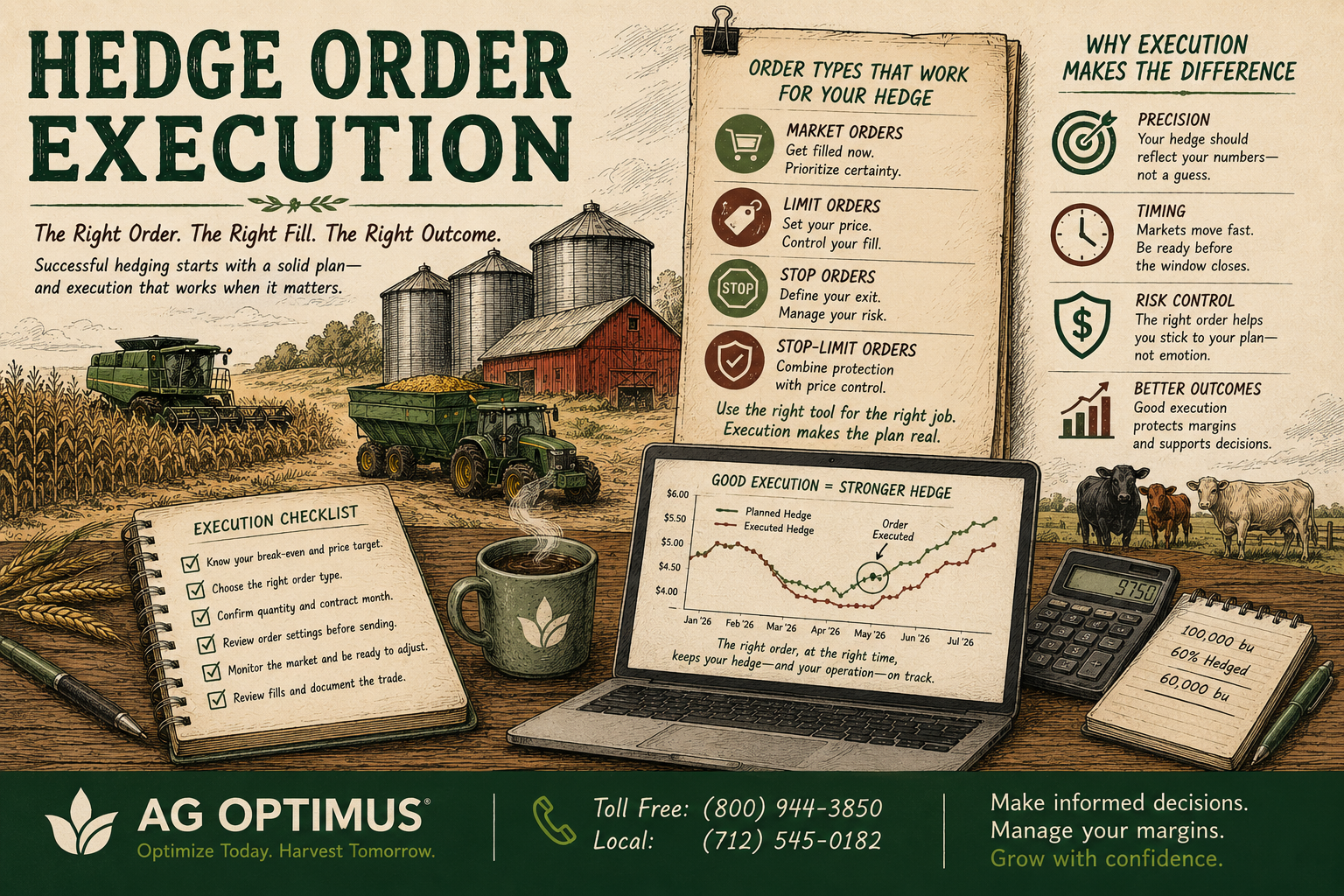
- A good hedge is not the highest print on the chart. It is an execution outcome that aligns with your break-even and local basis while fitting your cash-flow needs and the realities of your operation.
-
- The screen price doesn’t guarantee your fill. Thin liquidity, fast markets, and queue position can leave you unfilled even when the market trades your number.
-
- There is no perfect entry, and no perfect exit. Judge a hedge order execution against your plan and break-even at the time you decide, not by the prices that print later.
-
- Hesitation could be a cost in grain hedging. If you’ve decided to hedge, watch your limit order if the market moves away.
-
- A hedge must fit your cash flow, not just your price outlook. A rallying market brings margin calls on a short hedge even while the crop gains value in the field.
What “Best Price” Really Means
The best possible hedge price is never just a board quote. Your final result is shaped by where you place the hedge, the local basis when you sell, the order type you use, hedge size versus actual exposure, and the timing of production and marketing decisions.
When a producer places a first hedge with our desk, the goal I emphasize is reducing price risk to create a stable business outcome, not squeezing every dollar from a futures position. A marketing plan stays on paper until an order establishes the position. Understanding your farm’s math and knowing how the order will behave together help new hedgers clear their biggest psychological hurdle.
Why First-Time Hedgers Struggle With Execution
New grain farmers and cattle hedgers do not begin by asking about price-time priority or order-book depth. They ask things like: Should I wait for a better price? Market order or limit order? What if the market trades my number and I still don’t get filled? What if I hedge now and it rallies another 20 cents? What if I get a margin call before I sell the grain or the cattle?
These are real questions rooted in hesitation, and the hardest part is: watching a futures position lose money while the physical crop gains value in the field, and understanding that this is the hedge working, not failing.
When a grower asks me, “What if it rallies another 20 cents after I hedge?” my response is always: “What happens to your balance sheet if it drops 40 cents and you did nothing?”
When the decision is made from your break-even math, go to hedging via trade execution.
Why Your Order May Not Fill Where You Expected
New hedgers often assume the screen price is what they will get. In reality, a fill depends on market conditions, liquidity, and timing — and on something almost nobody explains to producers: your position in the execution queue.
The exchange fills the best price first; when several orders rest at the same price, the earliest arrival takes precedence. So if December corn trades at $5.00, a sell limit at that price won’t automatically execute — earlier orders at $5.00 stand ahead of yours, and partial market activity can leave you unfilled.
Your Place in Line: What the Queue Looks Like
This is why “the market traded my number” and “I was filled” are two different sentences — hedge order execution lives in that gap. It is also why an experienced desk treats a limit order as a plan that may need a decision behind it: if the hedge must go on today, the queue risk itself is a reason to consider paying the tick and using a market order.
Corn: One Hedge, Three Execution Outcomes
A corn producer expects to harvest 50,000 bushels and wants to hedge 25,000 to start — 5 December contracts. December corn is trading at $4.90. Prices are hypothetical.
Choice 1 — market order. $4.90 covers the break-even; the decision is made: sell 5 December corn at the market. The fill might come at $4.89¾ or $4.90. The producer is hedged, and emotion is out of it.
Choice 2 — sell limit at $5.00. The producer wants exactly $5.00. If the market touches $5.00 briefly and backs off, the queue described above can leave the order unfilled. He avoids chasing the market but risks never being hedged.
Choice 3 — sell stop at $4.78. He is not willing to sell at $4.90, but wants the hedge to trigger if the market breaks. If corn falls, the hedge activates automatically. Stop orders trigger execution; they don’t guarantee a fill at a given price, so in a fast break the fill can come below $4.78.
Cattle: A Trigger, Not a Frozen Moment
Now take a cattle feeder who expects to market fed cattle and wants coverage if futures slide before sale time. Suppose live cattle futures are trading at $224. A sell stop can rest at the level where the economics no longer justify staying unhedged — the same hedge-trigger logic from the livestock side of the order types article.
The framing fixes a real mental hurdle: producers aren’t trading cattle futures; they’re hedging cattle they already own. If the market breaks to that level, nobody wants to be paralyzed in the truck deciding whether to sell. The order does the job that was decided on a calmer day.
There Is No Perfect Entry — and No Perfect Exit
A crucial point often omitted for new hedgers: this matters just as much when you’re exiting the position as when you’re entering it.
You won’t sell the high. Your entry fill will often be a tick or two worse than the screen. And when the hedge comes off — against a cash sale, or as part of adjusting hedge orders as the market moves — your exit will not be the perfect price either. There is no such thing as an ideal hedge with a perfect exit. The producer who demands one will find a reason to never place the order.
And then there is the most destructive habit of all: watching the board after you are out. A producer lifts the hedge at $4.60 against a cash sale. If corn falls to $4.40, he feels brilliant; if it rallies to $4.85, he regrets the hedge. Both reactions grade a risk-management decision like a trade. The prices that print after your exit are information for the next decision. They are not a verdict on the last one.
Judge the hedge at decision time: was the size right, did the price work against your break-even, and did the order fill as intended? That is the whole scorecard for hedge order execution. If yes, it was a good hedge, regardless of the market’s later moves. Producers who keep score against the season’s best prints become overly cautious the next year, and that caution costs more than slippage.
The Cash-Flow Reality of Margin
One reason new hedgers obsess over the best price is worry about margin calls. A grain producer who sells futures and watches the market rally will face cash margin calls even though the crop in the field is worth more. A hedge must match your price outlook, your cash-flow tolerance, and your relationship with your lender. Even a well-executed hedge can strain an operation that hasn’t planned for margin calls when the market rallies. The mechanics are covered in the margin section of the order types article; the short version is: talk to your broker and your lender before the first order, not during the first rally.
A Better Way to Think About the “Best Price” Question
For a first-time hedger, the healthiest shift is this: stop trying to pick the perfect top or bottom, and start making an executable, defensible business decision. A strong hedge decision looks like this: match your hedge size to your physical exposure; choose the order type based on whether you need a certain fill or a certain price; understand what the queue and trigger mechanics can do to your hedge order execution; and talk to your broker and lender about margin before placing the first order.
That is what experienced hedgers and brokers mean by a good price. It fits your plan, executes properly, and does its job for the operation — it isn’t necessarily the month’s highest trade.
Ready to place your first hedge? We walk grain and livestock producers through order choice, fills, and margin planning before the first order goes in — at a desk, with an experienced broker.
Call us toll-free at (800) 944-3850 or locally at (712) 545-0182 to speak with an Ag Optimus broker.
Frequently Asked Questions
Why didn’t my limit order fill even though the market traded at my price?
Because of your place in the queue. Orders resting at your price before yours arrived are served first, and if the volume that traded at your level was absorbed by the line ahead of you, your order stays open, unfilled. Two practical responses: ask your broker where the order stands, and if the hedge genuinely must go on today, weigh whether queue risk is worth more than the tick you would concede with a market order.
Is a market order a bad way to place a hedge?
Not necessarily. Once the decision to hedge is final, a market order’s guaranteed execution typically justifies paying a tick or two. The real mistake is an unfilled order sitting on the book while the price your plan needed moves away.
Should I wait for a better price before hedging?
If your break-even math says the current price works for the operation, waiting is speculation, not a plan in our opinion. If you have a specific higher target from that math, a resting sell limit at your number lets the market come to you — with the understanding that it may never fill. The distinction is whether the decision is made or you are still deciding.
What if the market keeps rallying after I hedge?
Then your crop or cattle are worth more, and the hedge returns a portion of that value to the market — that is it doing its job, not failing. Weigh the other direction at decision time: consider how a 40-cent break would affect the balance sheet with no hedge on. Coordinate margin cash flow with your lender so a rally doesn’t force an unwanted exit.
How do I judge whether my hedge was a good one?
Evaluate hedge order execution at the decision point: confirm the size matched your physical exposure, the price worked against your break-even, and the order filled as intended. Treat prices that appear after entry or exit as information for the next decision, not a verdict on the last one. Scoring hedges against the best prints makes you overly cautious, and that caution costs more than slippage.
Should I keep watching the market after I lift a hedge?
Watch the market for your next decision, not to re-grade your last one. After you remove a hedge against a cash sale, accept the exit as part of the plan that produced it. If watching the board makes you doubt a call that was sound when you made it, that doubt — not the price — will hurt the next hedge.
This material is general educational content from Ag Optimus. Ag Optimus is an introducing broker registered with the NFA and CFTC (NFA ID 0481133). Price levels referenced are hypothetical and used for illustration only. Order execution is subject to market conditions, and no order type guarantees a specific fill price. Trading futures and options involves substantial risk of loss and is not suitable for all investors; you may lose more than your initial deposit. Past performance does not guarantee future results. Every operation is different; assess any strategy against your production costs, marketing plan, financial situation, and risk tolerance.