
No pressure, no jargon — just a conversation about your operation.
PRICE VOLATILITY
Grain Price Risk Management
Prices move fast. Margins are thin. And you can't un-sell your crop once the market crashes. Here's how agricultural producers protect themselves before it's too late.
Talk to a Broker
We'll reach out within one business day. All conversations are confidential.
Nobody Rings a Bell at the Top
If you could see the price crash coming, you’d sell into it. But corn can rally $0.40 in a week on a hot July forecast, then give it all back when the USDA report drops the following Tuesday. Soybeans move on Chinese demand signals nobody sees coming. Feeder cattle swing on weather, feed costs, and things that haven’t happened yet.
The problem isn’t that prices are volatile. It’s that you have real deadlines. Harvest is coming whether the market is ready or not. Storage costs money. Loans have due dates. Every day you wait for a better price is a day the market might decide to move the other way.
01
Layered uncertainty
Yield risk sits on top of price risk. A hedge that looks right in May can be wrong in three different directions by October.
02
Basis moves independently
The futures price and your local cash price don’t always move together. Basis can widen or tighten in ways that change your net even when futures look stable.
03
Margin calls are real
Operations that aren’t prepared end up making the worst possible decision at the worst possible time — closing a good hedge because they ran out of cash.

Sell Futures Before Harvest
Lock in your revenue now by selling a futures contract at today’s price. If the market drops, your gain in the futures position offsets the lower cash price at harvest. If prices rise, you’ve given up that upside — but you’ve protected against the downside that could have wiped out your margin.
BEST FOR THIS OPERATION:
Operations that have a clear cost of production and need a minimum price floor to remain profitable. The goal isn’t to maximize price — it’s to eliminate the risk of a catastrophic outcome.
Disclaimer: Futures losses can exceed initial margin.

Buy Put Options — Set a Price Floor
A put option gives you the right — but not the obligation — to sell at a specific price. Pay a premium like an insurance policy. If prices fall below your strike, your put gains in value and offset the loss in the cash market. If prices rally, let the option expire and capture the higher price instead.
BEST FOR THIS OPERATION:
Producers who want downside protection without giving up a potential price rally. Particularly useful heading into volatile USDA report windows or summer weather markets.
Disclaimer: Purchased options can expire worthless, resulting in a loss of the entire premium paid. Sold options carry potentially unlimited risk, with losses that may far exceed the premium received. Cash, Futures, or Options may not move in tandem.

Scale-In / Systematic Pricing
Price portions of your crop at regular intervals — 20% in February, 20% in April — to average out over the marketing season. This removes the psychological burden of timing decisions and captures a blend of highs and lows rather than betting everything on a single moment.
BEST FOR THIS OPERATION:
Producers who find themselves paralyzed by indecision or consistently looking back at missed opportunities. Systematic pricing replaces gut feel with a repeatable plan.
Disclaimer: Incremental pricing does not guarantee a favorable average price; portions of production may be priced below seasonal highs.
OUR TECHNOLOGY
Getting the Decision Right
Takes the Right Information
Strategy only goes so far. The harder problem is timing — knowing when momentum is shifting, what local basis is doing, and whether a price you're looking at is actually better than it looks. These tools are built for that.



Ready to Take Control of Your Crop Marketing?
Start with a conversation. We'll help you figure out the right strategy for your operation.
Who This Affects
Price Volatility Doesn't Discriminate
The same market that makes a corn farmer nervous about harvest prices is making a cattle feeder nervous about input costs and a commercial hedger nervous about margin compression. The problem looks different — the solution is the same.


LATEST ARTICLES
Check out the latest industry articles
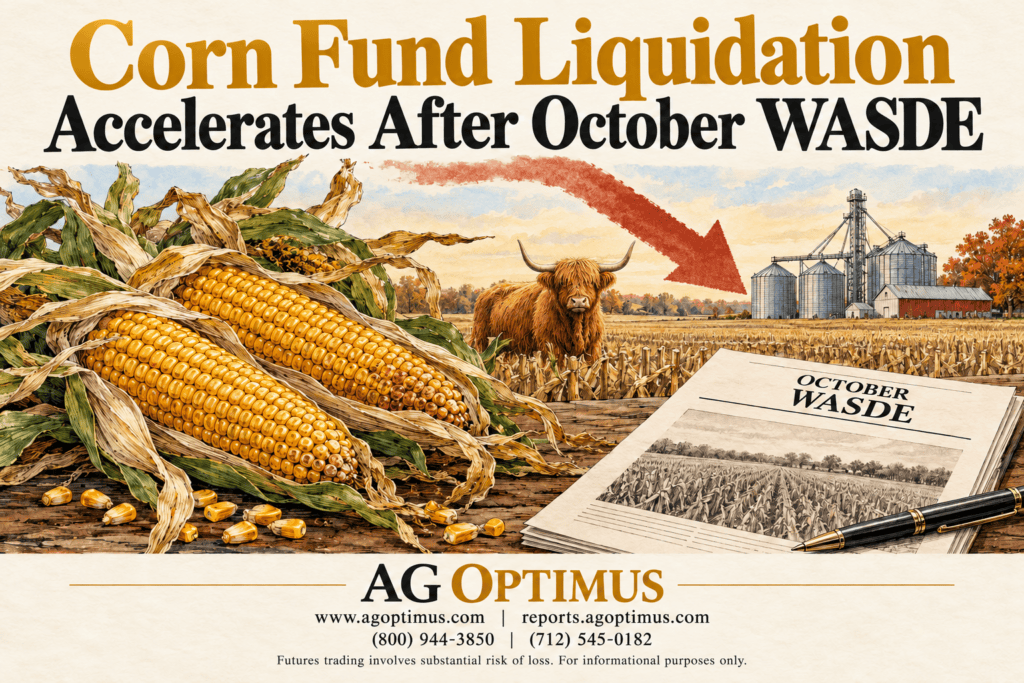
Corn Fund Liquidation Accelerates After October WASDE
Corn Fund Liquidation Accelerates After October WASDE
Corn Managed Money Net Long Falls Before October WASDE
Corn Managed Money Net Long Falls Before October WASDE
October WASDE Actual vs. Estimates: Full Scorecard
October WASDE Actual vs. Estimates: Full Scorecard
October WASDE: Corn Carryout Jumps to 1.849 Billion Bushels
October WASDE: Corn Carryout Jumps to 1.849 Billion Bushels
Grain & Livestock COT Report — Oct 5, 2026 · COT positioning as of Tuesday, Sep 29, 2026
Grain & Livestock COT Report — Oct 5, 2026 · COT positioning as of Tuesday, Sep 29, 2026
FAQs
Common questions about grain price risk management, hedging strategies, and how to protect your crop revenue before the market moves against you.
There’s no universal answer — but there is a better question: does today’s price, combined with your cost of production and storage costs, leave you profitable? If yes, pricing all or a portion now removes the downside risk of waiting. Most experienced grain marketers don’t try to hit the top — they build a plan that locks in profitability first, then use options or remaining bushels to capture additional upside if prices rally.
A forward contract is an agreement with your local elevator to deliver grain at a fixed price on a specific date — simple, no margin account, no daily settlement. A futures hedge involves selling contracts on the exchange, giving you more flexibility to adjust the position as conditions change. Both are legitimate tools; the right choice depends on your scale, cash flow flexibility, and how much basis risk you want to manage.
A price floor is a minimum selling price established using a put option. You pay a premium — like crop insurance for your marketing — and in return you have the right to sell at your strike price no matter how far the market falls. If prices rally above your strike, let the option expire and sell at the higher cash price. Many producers set their floor at or near their cost of production to ensure they can’t lose money on the year regardless of what the market does.
If you hedge with futures and the market moves against your position before you’re ready to sell the physical grain, you may receive a margin call — a request to deposit additional funds to maintain the position. This isn’t a loss; it’s a cash flow requirement. If prices later fall back as expected, those funds are returned. The key is knowing this is coming and having a line of credit or cash reserve in place. Your broker should walk you through this before you place the first trade.
Yes. Cattle feeders face price volatility on three fronts simultaneously: feeder cattle purchase prices, fed cattle selling prices, and feed input costs (primarily corn). Managing even two of those three exposures can dramatically stabilize annual margins. AgOptimus brokers work across both grain and cattle markets — which means they can look at your whole operation, not just one side of it.