By Ryan Griffeth
Ryan Griffeth is a registered broker with AgOptimus and a former CME local trader with more than 20 years of experience, having personally executed millions of trades representing billions in notional value. He works with commercial operators across the grain, livestock, ethanol, food manufacturing, and energy sectors.
This article is the opinion of Optimus Futures.
A hedge is not a set-it-and-forget-it decision. Adjusting hedge orders as the market moves is part of the job.
In the previous article, “Futures order types for agricultural hedging,” we explained how to establish a hedge using market, limit, and stop orders to convert break-even calculations into a working position. This part explains what happens after a hedge is filled. When the market moves in your favor, the short futures position placed against your crop or cattle gains value, and a new set of decisions begins.
Adjusting a working hedge isn’t about excitement. It is about matching the paper position to changing yields, cash sales, and feed costs. Here is how we handle adjusting hedge orders on the desk.
Key Takeaways: Adjusting hedge orders
- The initial order sets up the hedge; every decision after that determines whether it still fits. Yield estimates evolve, cash sales happen, and feed costs move. A resting order remains unaware of these developments.
- Tightening a stop on a hedge is a decision to re-enter exposure. When that buy stop activates, the hedge is removed, and your bushels are unpriced again. Make that decision deliberately rather than because the board number looks appealing.
- Scale out when the physical element changes. A cash sale to the elevator or a change in headcount is a reason to buy back contracts. A round number on the chart is not.
- Positioning a hedge must match your physical exposure. If production estimates fall or cattle are sold, re-size the hedge; otherwise, you are carrying risk you no longer need.
- Review every working order after a shock. USDA reports, basis moves, and major cash sales all change what your resting orders should be doing.
Why Adjusting Hedge Orders Matters
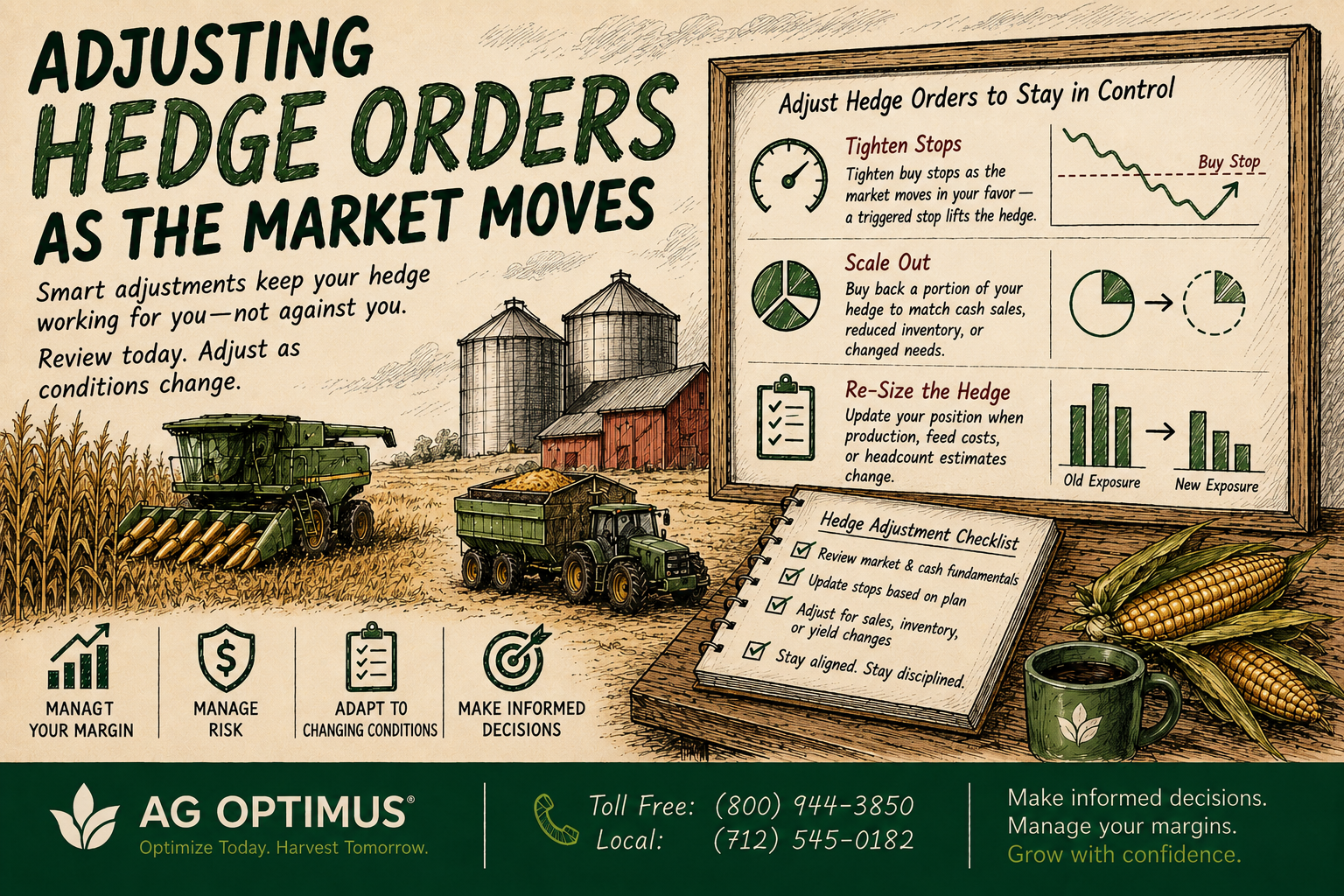
Maintain the hedge’s link to specific business factors: expected production levels, cost of gain, local basis, and sale timing. Those factors differ on every operation, so there is no single formula. But once the market moves in your favor, adjusting hedge orders comes down to three actions, again and again on the desk:
- Tightening a stop so a favorable price movement is not fully given back.
- Scaling out — buying back part of the position to match a change on the cash side.
- Re-sizing the hedge when physical inventory or production estimates change.
A Frank Point First: Adjusting a Hedge Re-Exposes the Farm
Before the examples, one thing needs to be said plainly, because most articles on this subject skip it.
The gain on a short hedge is not a standalone profit. It is the offset to a crop or a pen of cattle that has declined in value. When you tighten a buy stop beneath a working hedge and that stop triggers, you have not banked a win. Lifting the hedge leaves your bushels unpriced and exposed to the next market move.
Sometimes that is exactly the right call: the move has run, your cash marketing is nearly done, and holding the hedge no longer serves the plan. But it is a decision to take exposure back onto the farm, and it requires a concrete, physical rationale.
The failure modes sit on both sides. When the stop is tightened too far, ordinary noise can trigger it and remove the hedge, and you watch the market resume its slide with nothing on. When the stop is set too wide, a real reversal gives back most of the favorable move, in exactly the year the operation needed that margin. No single stop distance avoids both problems; the fix is process-based, not a number. A predetermined hedge plan names the specific triggers for an adjustment: price points, cash sales, production shifts, or set dates. When markets shift, follow the plan rather than debate it.
Grain Example: Managing a Short Corn Hedge
A corn producer expects to harvest 100,000 bushels and decides to hedge 60,000 of them by selling 12 December corn contracts (5,000 Bushles per Futures contract). Prices here are hypothetical.
Step 1: The hedge goes on
December corn is trading at $5.10. The farmer makes the decision and sells 12 contracts. Once the decision is made, you establish the hedge. You do not rely on a limit order that may never fill.
Step 2: The market breaks, and the stop comes down
A few weeks later, December corn hits $4.80. The short hedge is doing its job, potentially compensating for the crop’s reduced market value.
Now the producer can place a buy stop above the current market price. Suppose he places it at $4.95. If the market turns and rallies through that level, the stop triggers, the hedge is lifted, and he retains 15 cents of the 30-cent move on the contracts. Where you set that line is the whole decision: staying close to the market preserves more of the price movement but triggers on minor fluctuations, while standing farther away tolerates those swings but gives more back when the stop fires.
Two reality checks. First, a stop activates an order; it does not ensure a fill at that price. If a USDA report gaps the market higher, the fill can come in worse than $4.95, and in a locked limit-up market it may wait until trading resumes — agricultural futures carry daily price limits and reach them more often than most markets. Second, remember what triggering means: the hedge ends, and the unsold crop returns to the market unpriced. That is the trade you make when you tighten.
On automation: retail platforms offer trailing stops that mechanically follow the market down. Our desk prefers to trail manually, reviewing the stop weekly against the market, the calendar, and the fundamentals, rather than relying on an automatic trail during volatile trade.
Step 3: A cash sale on the farm, so contracts come off the board
Corn keeps sliding to $4.60, and the producer signs a forward cash contract with the local elevator for 30,000 bushels. Those bushels are now priced in the cash market, so the futures covering them are no longer needed. He buys back 6 of the 12 contracts with a buy limit order to keep paper aligned with physical.
That is scaling out done properly. A change on the farm — a cash sale — prompted it, not a number on a chart. After the fill, review the remainder immediately: with 6 contracts working against the 30,000 bushels still unsold and hedged, the buy stop may be tightened, left alone, or reconsidered entirely, depending on where the cash marketing stands.
The Corn Sequence at a Glance
Livestock: Managing Margins, Not Just Prices
Adjusting hedge orders works the same way for cattle; the mechanics are identical. The economics driving the decisions are entirely different.
When a backgrounder rests a sell stop under the feeder cattle market, it is tied to his cost of gain. If the market drops and the short hedge gains value, the decision to scale out is not based on a profit target. It is based on physical considerations: whether the cattle are gaining faster than expected and moving the marketing window forward, whether corn prices have fallen and improved the feeding margin, or whether a cash arrangement is in place with a packer.
The alignment rule is most stringent here. A feedlot operator who hedged 100% of near-term exposure, then sold cattle or revised the head count, is now short more futures than he has animals. That excess is not a hedge; it is a speculative short that must be covered when physical exposure changes.
The Cattle Sequence at a Glance
The same discipline, on the livestock side.
The Board Is Not the Whole Picture: Basis
Everything above refers to the futures market. Your actual sale price includes a second component: basis, the difference between your local cash bid and the board price. A futures hedge does not manage basis, and a perfectly sized, perfectly managed hedge can still disappoint if local basis widens 30 or 40 cents while you watch the board.
That matters when adjusting hedge orders. If the board falls while the local basis widens, hedge gains overstate performance; favor gentler tightening rather than stronger. Track basis together with the futures position, and monitor the local bid whenever you check working orders. Basis decisions are separate from futures decisions; treat that timing separation as a practical tool.
A side note on options: some operations eliminate stop-management tasks by buying a put to set a price floor, at the cost of the premium, or by using a collar, where a sold call offsets part of that premium in exchange for capping the upside.
What situations would require a hedger to use a buy stop on a short hedge?
For a hedger with a secure crop and stable financing, there could be none: the hedge is placed, held, and offset with a buy order when the cash grain or cattle are sold. A buy stop earns its place when something behind the hedge may change. First, as a pre-planned exit written into the marketing plan — a level above which the producer wants bushels open again to sell cash into strength. Second, in a short-crop scenario, where the same weather rallying the market is shrinking the crop, and part of the short position no longer has bushels behind it. Third, as a cash-flow decision, when margin calls in a rising market strain the operation’s financing — a real situation, though the better fix is to plan margin cash flow with a lender in advance. In every case, the trigger is a change in the plan, the production, or the financing, not the board price alone.
Practical Rules From the Desk
- Move stops with purpose. Tighten only when the adjustment reduces exposure or preserves a favorable move, and know which failure you are steering away from: too tight is triggered by daily noise, too wide gives the move back. Your written plan decides, not the day’s mood.
- Scale out based on the farm, not the chart. Plan exits in increments tied to actual bushels, head counts, or feed needs rather than round contract numbers.
- Review everything after a shock. Review working orders, including GTCs, after USDA reports, basis shifts, or large cash sales.
- Treat every order as part of the plan. Each adjustment belongs to the broader marketing strategy, not to an isolated decision made in the heat of a move.
The hardest part of hedging is not placing the first order. It is maintaining discipline while adjusting hedge orders, so the work stays hedging and never drifts into trading. A broker who understands your operation and the order book can help with exactly that.
A working hedge deserves a second set of eyes. Our team helps grain and livestock producers keep futures positions aligned with their operations as conditions change: reviewing stops, timing scale-outs relative to cash sales, and re-sizing when physical exposure shifts.
Call us toll-free at (800) 944-3850 or locally at (712) 545-0182 to speak with an Ag Optimus broker.
Frequently Asked Questions
When should a producer start tightening stops on a working hedge?
Tighten stops when adjusting hedge orders, once a favorable move is significant and a clear physical rationale exists. The timing depends on your break-even point, cash flow needs, and the amount of unsold exposure remaining. Be guided by written hedging rules, not emotions.
What actually happens if my tightened buy stop triggers?
The short hedge is closed. You retain the portion of the move between your entry and the fill, but the unsold crop or cattle behind the hedge are unpriced and fully exposed. Tightening a stop is a re-exposure choice and should be treated accordingly.
Can a producer scale out of only part of a hedge?
Yes. Producers often buy back part of a short hedge after a partial cash sale or to realize gains on a favorable move while maintaining coverage on the remaining inventory. Afterward, check which orders remain active against the reduced position, and replace or cancel as needed.
Does tightening a stop guarantee I keep the favorable move?
No. A stop order activates execution but does not ensure the fill price. In a fast or thin market, especially around limit moves in agricultural futures, the fill can come in worse than the stop level, and in a locked market, it may wait until trading resumes.
How is scaling out different for grain versus cattle?
Grain scaling out depends on yield estimates and the timing of cash sales. Livestock scaling out depends on headcounts, marketing windows, and feed exposure. In both cases, keep futures in line with your physical exposure; hedging beyond it is speculative.
Should I change my working orders around USDA reports?
Only change orders under a pre-defined plan; do not move stops while the market is reacting. If you expect extreme volatility, decide in advance whether to cut size, widen stops to absorb the noise, or exit entirely.
Does my futures hedge manage basis risk?
No. A futures hedge covers only the board price. Basis, the difference between your local cash bid and the futures market, is driven by local supply, transportation, and buyer demand, and it can widen even while your hedge gains value. Monitor basis separately when you check working orders; basis decisions are separate from futures decisions.
This material is general educational content from Ag Optimus, a DBA of Optimus Futures LLC. Ag Optimus is an introducing broker registered with the NFA and CFTC (NFA ID 0481133). This is not personalized trading advice or a recommendation to trade futures or options. The referenced price levels are hypothetical and used for illustration only. Order execution is subject to market conditions, and no order type guarantees a specific fill price. Trading futures and options involves substantial risk of loss and is not suitable for all investors; you may lose more than your initial deposit. Past performance does not guarantee future results. Every operation is different; assess any strategy against your production costs, marketing plan, financial situation, and risk tolerance.