By Nathan Harris · Corn producer and cattle feeder, and a registered broker with Ag Optimus. This article is the opinion of Ag Optimus.
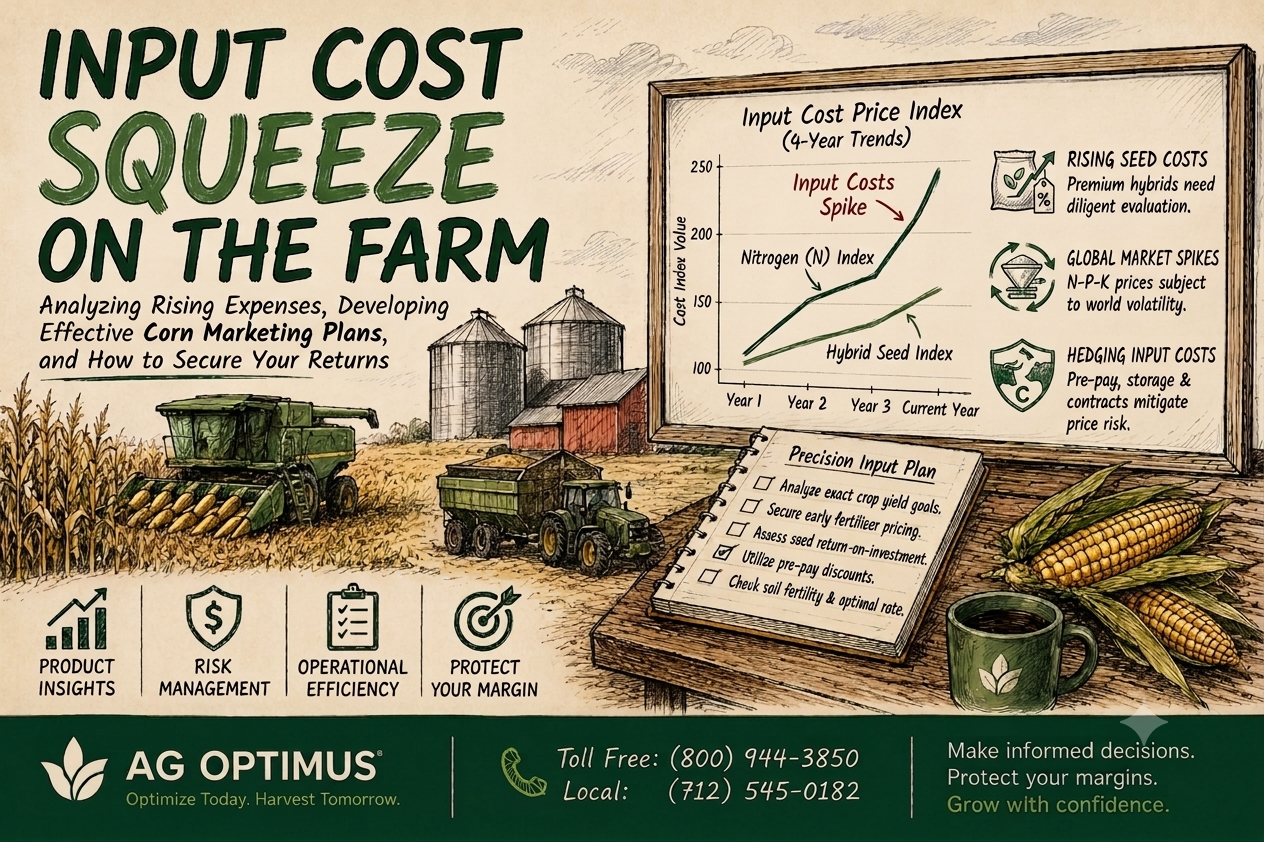
The second half of 2026 presents difficult market conditions: diminishing prices compared to input costs, a market still processing substantial supplies, and continued uncertainty around weather, exports, and basis. A marketing plan will not make that go away. What it can do is give you a process that eliminates guesswork and prevents one bad call from defining the year.
The goal is not to pick the top. It is to build a process that manages margin, spreads risk across time, and keeps any single decision from carrying the whole crop.
Key Takeaways
-
- Begin with your break-even point. Calculate cost per bushel using land expenses, input costs, interest payments, and equipment depreciation, then use that as your price target.
-
- Avoid concentrating sales in any one period. Choose concrete pricing windows before and after harvest and commit a portion of your bushels to each.
-
- Record the local basis when you price. Compare it to the futures board to get your true margin, since a weak local basis takes an already thin margin and makes it thinner.
-
- Store only when the math supports it. Store when expected basis improvement exceeds interest, shrinkage, and quality risk, not on hope.
-
- Hedge to manage a particular risk. The purpose of hedging is to manage a specific exposure, not to predict the market. A broker-assisted plan matches the tool to the risk.
If it feels overwhelming, start here
If it feels overwhelming, do these three things:
-
- Know your break-even. Calculate cost per bushel including land, inputs, interest, and equipment. If you don’t know your number, you can’t know what a good price is.
-
- Set price and time targets. Choose two or three dates before harvest and one or two after, and plan to sell 10–20% of your crop at each target when futures reach levels that suit your farm.
-
- Know where your floor is. Ask your crop insurance agent to explain your coverage limits, so you can set marketing targets that address the remaining risk.
This will not catch the top of the market. That is not the point. The point is to keep one bad decision from wrecking the year.
Start With the Numbers You Control
A corn marketing strategy starts with the numbers on your farm, not the headline on the futures board. Before you consider hedging instruments, basis contracts, or on-farm storage, evaluate your estimated production costs, estimate likely yield ranges, and calculate a per-bushel break-even.
Work backward from a realistic break-even price per bushel. That number does not guarantee a good outcome, but it shows whether to act, wait, or cut losses when a hoped-for rally fails to arrive. Consider taking action whenever the price covers your production costs plus an acceptable margin.
Know What Your Insurance Floor Does — and What It Doesn’t
Crop insurance is your safety net against bad yields, which frees your marketing to focus on price swings. Knowing what your coverage does lets you price confidently before harvest because you know what lies beneath you if yields disappoint.
Discuss coverage levels with your crop insurance agent, not your futures broker. Crop insurance agents handle policy specifics; our role is to develop the marketing strategy that complements your coverage. Know your policy before making pricing decisions.
Avoid All-or-Nothing Sales
One of the most useful ideas in grain marketing is also the simplest: don’t let the whole year ride on one decision. Use a time-based selling plan: schedule several sales dates or windows across the year rather than relying on a single trigger.
This builds discipline and reduces emotional reactions, keeping you from being left unpriced during a downturn or from committing fully to a short-lived weather rally. It doesn’t promise a better average price. A single optimal sale often outperforms, and hindsight isn’t a marketing plan.
Meaningful pricing opportunities for corn often emerge before harvest. Use pre-harvest windows and keep the remaining crop flexible so you can capture value without trying to time every bushel.
Basis Matters More Than Most Farms Realize
Your cash corn price is not just a futures story. Basis is the gap between your local cash bid and the futures price, and it reflects transport, storage, regional supply, and buyer demand. For a clear primer, see corn basis explained.
In a low-price year, a weak basis takes an already thin margin and makes it thinner. Make basis part of the marketing discussion from the beginning, not at the scale on delivery day. If futures look acceptable but your local basis is historically weak, decide whether to store your grain or separate the futures and basis decisions using the appropriate contract.
The Elevator Phone Call: A Basis Reality Check
Basis is local, and it moves fast. Before harvest, and again monthly if you’re storing, contact two or three elevators or processors where you deliver and ask:
-
- What’s your current cash bid and basis?
-
- Do you expect the basis to strengthen after harvest, and why?
-
- Are you turning away grain because you’re short on storage space?
An elevator flooded with old crop can flatten basis even when futures rally. That five-minute call will often tell you more than any national report. Write the numbers down, and note who gave you the projection: the elevator, the buyer, or an analyst. If your current basis is 60 cents under and the elevator says it normally runs 20 cents under by December, that 40-cent gap is the decision in front of you.
Storage Should Be Measured, Not Assumed
A common mistake is assuming storage automatically improves the outcome. Storage helps in some years, particularly when basis improves enough to cover the cost of holding. But it also brings interest on operating capital, drying and shrink loss, and higher mold and quality risk. Expected basis gains can simply fail to appear.
Treat storage as an active choice. Add storage fees, insurance, interest, and expected shrink to get your full ownership cost, then compute the break-even improvement per bushel you need over the months you plan to hold, and compare that to the basis and carry you actually expect. If storage costs and risks exceed likely price appreciation, sell. In a tight-margin year, the cost of waiting runs higher than most farms expect. For a fuller walkthrough, see what to do when corn basis blows out at harvest.
Don’t Let Old Crop Freeze New Crop
If you still have last year’s corn in the bin heading into a new season, you are not alone. Don’t let those bushels influence this year’s decisions. Separate them on paper: price the old crop against its own break-even, plus the storage you’ve already sunk into it, and price the new crop against next year’s break-even. One rally rarely fits both, and plenty of farms wait for a price that bails out last year’s bins and clears margin on next year’s crop, missing both opportunities.
Hedging Is a Risk Tool, Not a Prediction Contest
Farms using futures or options primarily focus on risk management. Hedging is not about proving you can outguess the market every week. It is about managing downside exposure, maintaining flexibility by spreading pricing across months, and separating pricing decisions across time.
That distinction matters because hedging often gets misunderstood as a bet on direction. In practice, hedging is one part of a broader plan covering production risk, basis, cash flow, and storage.
Ask what specific risk you are trying to manage, then match the tool to it. Worried about harvest-price declines? A short futures hedge or an HTA may fit. Concerned about basis swings? A basis contract may be the better answer. Want to keep the upside while setting a floor? That points toward a put option. Ask your broker what each one costs, how the timing works, and how it would apply to your crop.
Matching the Tool to the Risk
| The risk you’re managing | Tool that fits | What you give up |
|---|---|---|
| Board price falls before I sell | Short futures hedge, or a hedge-to-arrive (HTA) contract | Upside if the board rallies. Futures carry margin requirements; HTAs may carry fees or roll costs. |
| Local basis weakens on me | Basis contract | You still carry futures price risk until the board is priced. |
| I want certainty on both, right now | Forward cash contract | Both pieces are committed at once, whether or not each is at a good level. Delivery is obligated. |
| I want a floor but still want the upside | Put option (or a put spread to cut the cost) | The premium you pay, plus time decay. A spread reduces cost but caps how far the floor extends. |
| Yield is still uncertain and I don’t want to commit bushels | Put option on a portion of expected production | Premium cost. But no delivery obligation if the crop comes up short. |
No tool on that list is better than the others. Each one trades something away to manage something else, and the right choice depends on which risk is actually keeping you up at night, how confident you are in the bushels, and what your cash flow can carry. That is the conversation to have with a broker before harvest, not during it.
Contracts and Their Tools: Forward, HTA, Basis
Beyond basic futures, many elevators and co-ops offer forward, HTA, and basis contracts, so you can choose futures timing and set a basis separately.
Hedge-to-arrive (HTA) contracts fix the futures price component but leave the basis to be determined before delivery, so they work well when futures look attractive while the local basis is weak but expected to improve. The trade-offs are real: you retain basis risk, may incur fees or roll expenses, and forfeit any gains from a subsequent futures rally.
Basis contracts do the reverse: they secure the local basis now while you wait for a better futures level. These fit when the local basis is historically strong.
Forward cash contracts set both futures and basis at once, giving immediate certainty but committing both even if levels aren’t ideal.
Choosing among them depends on your read of futures versus local basis, your delivery logistics, and your relationship with the buyer. Check with your elevator on how any contract affects farm-program eligibility before you sign.
Options: Setting a Floor Without Giving Up the Upside
Options give you a price floor while preserving upside. Unlike forward contracts, they operate asymmetrically: buying a put option sets a floor on a portion of the crop while leaving the upside open if the market rallies. The premium is what you pay to maintain that floor.
Put Spreads and other combinations can reduce that upfront cost when you don’t need full coverage. More advanced strategies involving sold options carry obligations, and those require experience and a clear understanding of the risks. Work these strategies through with a broker instead of going it alone.
Align your strategy with the risk for each bushel lot, and understand how it interacts with your basis and your insurance floor.
Using Market Context Like COT Data
COT reports provide insight into how commercial hedgers are positioned relative to speculators. When prices feel stuck, positioning extremes or shifts can hint at changing sentiment. Use COT as context, not a timing signal, and pair it with your break-even numbers and local basis tracking.
A Practical Framework for 2026
A workable corn marketing strategy looks less like a bold call and more like a checklist.
-
- Project realistic production and calculate your break-even point.
-
- Understand your insurance floor coverage to determine what additional marketing is required.
-
- Set a price range that meets your margin objectives. It doesn’t have to be the year’s high.
-
- Stage sales across pre- and post-harvest, so no single sale determines the year’s outcome.
-
- Because local bids can swing independently of the board, track basis separately from futures as harvest approaches, and consider an HTA or basis contract when local conditions call for it.
-
- If on-farm storage costs and quality risk exceed the expected basis improvement, sell rather than store.
-
- Size each hedge to what you can defend: a share of projected bushels you are confident in, using puts to cap downside where yield is still uncertain.
-
- Monitor the broader context (positioning, weather, policy) to adjust as needed, without letting it override the farm-specific plan.
When margins are thin, a written pricing plan with clear hedging rules reduces downside risk more reliably than trying to time USDA reports or weather swings. It’s a practical, low-drama plan, and that is exactly the point.
Building a plan beats guessing at a price. We calculate your break-even and margin targets.
We monitor basis at your delivery points, map practical sales windows, and talk through whether on-farm storage or a specific hedge fits your cash flow. Our brokers farm and feed too.
Call and talk it through: Toll Free – (800) 944-3850 Local – (712) 545-0182
This material is general educational content from Ag Optimus. Ag Optimus is an introducing broker registered with the NFA. Futures, options, forward, hedge-to-arrive, and basis contracts involve risk, including loss, and may not be suitable for every producer. Past performance does not guarantee future results. Every operation is different; assess any strategy against your production costs, marketing plan, financial situation, and risk tolerance. Questions about crop insurance should be directed to a licensed broker; farm program questions should be directed to your elevator or local FSA office.
Frequently Asked Questions
What is the best corn marketing strategy when prices are low?
There is no single best strategy. In a low-price year, know your break-even point first. Then spread sales across multiple pricing windows, track basis separately from futures, and use hedges to manage specific risks. Structure beats trying to outguess the market when margins are thin.
How do I know if a corn price is actually good?
Compare it to your break-even, not to the yearly high. Calculate cost per bushel using land expenses, input costs, interest payments, and equipment depreciation. Consider taking action whenever the price covers your production costs plus a margin you find acceptable. Without a break-even number, you cannot tell a good price from a bad one.
What is the difference between an HTA and a basis contract?
An HTA establishes the futures price now and lets the local basis be set later, which is useful when futures look acceptable, but local basis is weak. A basis contract secures the local basis now while you wait for a better futures level.
Should I store corn or sell it in a low-price year?
Treat storage as an active choice: weigh expected price gains against storage costs, quality risks, and your cash-flow needs. Store only when the probable basis improvement combined with any carry exceeds the costs of interest, shrinkage, and quality loss. If storage costs and risks exceed likely price appreciation, sell.
Should I hedge my corn, and with what tool?
Name the risk first, then match the tool. Worried about harvest-price declines? Consider a short futures hedge or an HTA. For basis swings, a basis contract may be better. To keep the upside while setting a floor, a put option does that at the cost of a premium. Ask your broker about costs, timing, and how each tool would work for your crop.
Does crop insurance replace a marketing plan?
No. Crop insurance serves as a safety net against low yields, while marketing operates on top of it to manage price risk. Knowing what your coverage does lets you price confidently before harvest. For questions about coverage levels, ask a licensed crop insurance agent, not a futures broker.