
By Nathan Harris · Corn producer and cattle feeder, and a registered broker with Ag Optimus www.agoptimus.com
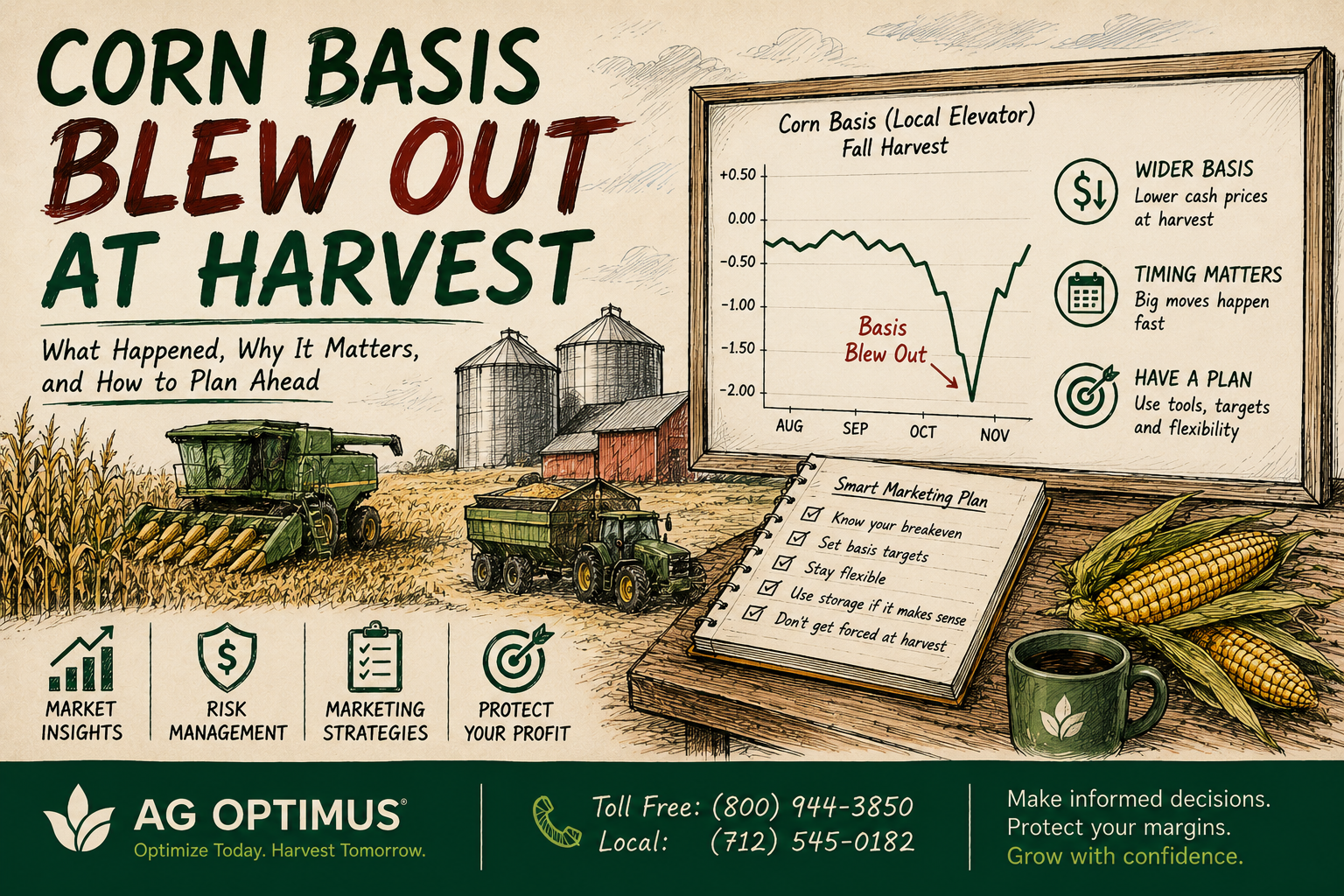
You hauled a load to town, and the cash bid was ugly. The futures board didn’t crash, but your local price did, because the elevator is packed, trucks are backed up, and there is more corn around than the local market can swallow right now. That is a blown-out basis, and it happens somewhere almost every fall. The good news: you have real options. Don’t decide alone or in a panic, and don’t react to the first number you see — get advice and work the problem.
This article assumes you already know what a basis is. If you want the fundamentals first, start with corn basis explained. Here, the focus is narrower: your basis already blew out at harvest, and you need to decide what to do about it.
Key Takeaways for Managing a Blown-Out Basis
-
- Identify the Signal: A wide harvest basis is a local supply-and-logistics problem, signaling that elevators are full and cannot immediately absorb more grain.
-
- Evaluate Your Options: Producers generally have three paths: sell cash to meet immediate obligations, store the grain if the math supports it, or use a basis/HTA contract to separate the futures price from the local cash price.
-
- Calculate Storage Costs: Never store on hope. Only bin corn if the expected basis improvement exceeds the combined costs of commercial interest, physical shrink, and storage fees.
-
- Broker-Assisted Strategy: Working with a full-service, broker-assisted firm like AgOptimus allows producers to build a marketing plan and utilize contracts without having to navigate the futures board alone.
What a Blown-Out Basis Is Telling You
A wide, unsightly harvest basis isn’t the elevator taking advantage of you; it’s a signal of local market conditions. When bins and elevators fill up faster than corn can move out, the local market says, in effect, “we don’t want your grain here, right now.” Heavy local supply, tight freight, or a bigger-than-expected crop all push the cash bid down relative to the board.
This perspective matters because it points to a practical response: a weak basis usually reflects supply, storage, or transport bottlenecks that ease as corn moves into use. A strong or improving basis, even when the futures board is low, is the opposite signal: local demand wants your grain, and you may be paid to move it sooner. Reading the signal right is the first step in figuring out what to do.
Your Three Real Choices
When basis blows out at harvest, the decision usually comes down to three paths, roughly in the order in which each makes sense.
1. Sell cash anyway. Accept the basis hit, move the grain, and prioritize liquidity and lower risk. If you have operating notes, land rent, or input bills due, moving corn now to meet those obligations is a reasonable way to manage cash flow, not a failure. There is no shame in selling to cover what you owe.
2. Store and wait for the basis to recover. If you have affordable, reliable storage and can cover the interest, shrink, and quality risks, holding corn until the local market clears can be profitable, because harvest basis may improve as bins empty into winter and spring. This only works if the math is correct, which is in the next section.
3. Separate the two decisions with a contract. A basis contract allows you to deliver grain and establish your basis today while leaving the futures price open for later pricing. A hedge-to-arrive contract does the reverse: it locks the futures portion now and leaves basis open. These tools let you act on whichever piece looks acceptable while waiting on the other, instead of accepting an unfavorable price on both at once.
Evaluate Storage Economics Before You Decide to Store
Here is where I see growers get into trouble: they store on hope rather than on math. “Basis has to get better than this” is a feeling, not a plan. Calculate storage costs and expected price improvement before storing, because many growers misjudge the math.
The rough calculation is simple. Add your expected basis improvement to any market carry, then subtract storage expenses, shrinkage losses, and interest on the capital tied up in unsold grain. When the projected return exceeds your risk threshold, storing may pencil out. If it doesn’t, storing is just paying to gamble on a basis recovery that may not come. Suppose commercial storage is five cents per bushel per month and interest on your operating line is three cents per month; holding corn for five months needs about a 40-cent basis gain to break even, before quality shrink.
Two cautions from extension research and experience. First, if everyone in the area stores grain, the expected basis gain may be smaller or delayed because the held grain hits the market at once. Second, long storage with poor aeration can cause quality discounts that wipe out any gain. Store good-quality corn carefully and with a plan; don’t store marginal corn in the hope it will improve.
Look Beyond Your Home Elevator
When your usual delivery point has a blown-out basis, check other locations. Ethanol plants, feed mills, and river terminals often maintain basis levels that differ significantly from your home elevator, because their supply situations and logistics differ. One buyer being full doesn’t mean they all are. Make sure to do the trucking math when you compare.
Should you truck corn over longer distances? Evaluate freight costs relative to the expected basis improvement and any storage expense before deciding. Compare the net per bushel: if the distant buyer’s stronger basis exceeds your freight plus storage, sell to that buyer. Run the three against each other rather than defaulting to the elevator down the road out of habit.
A Practical Compromise: Split the Decision
The choice is rarely all-or-nothing. A common, sensible move is to sell enough now to meet your obligations and cut your risk, then price or store the rest only when carrying costs are justified by the expected carry. That way you manage cash flow without selling the entire crop into the year’s weakest basis, and you keep some bushels positioned for a better local market later.
One practical note before you sign anything: basis contracts and similar tools can affect how bushels qualify for marketing-loan eligibility and other farm-program benefits. Those rules are outside the broker’s purview, so check with your elevator and your local FSA office to see how a given contract is handled before you commit.
Get Ahead of It Before Next Harvest
In our opinion, the best time to address a harvest-basis blowout is before it happens. If your delivery points have a history of basis collapsing at harvest, that pattern is a planning tool. Monitor the basis at each delivery location over several years, or work with someone who does, so you know when it usually bottoms out rather than relying on generic state averages.
With that history in hand, you have pre-harvest moves available. If the basis usually weakens sharply at harvest where you deliver, you can set the basis early, namely, lock a basis with your elevator using a basis or forward contract before the elevators jam. Or set up storage and credit in advance: reserve bin space, line up your grain merchandiser, and confirm a bank credit line or stored-grain loan. Plan ahead during a quiet season instead of making rushed decisions at harvest.
Don’t Make This Call Alone in a Panic
A blown-out harvest basis feels like a trap, but it is a decision with real, workable options: sell and move on, store if the math works, or split the futures and basis with a contract. The goal is to sustain your margin and keep the operation sound, not to pursue every extra cent from an unprofitable local market.
The one thing worth avoiding is deciding alone, in a rush, with a truck idling at the scale. Talking through your own basis history, storage costs, and cash needs with someone who works these markets can turn a panic into a plan. The team at Ag Optimus works with corn growers and mixed crop–cattle operations on exactly these harvest decisions.
Call and talk it through: Toll Free – (800) 944-3850 Local – (712) 545-0182
This educational material is from Ag Optimus. Trading these products carries a high risk of loss and may not suit all producers. Past performance does not guarantee future results. Every operation is different; assess any strategy against your production costs, marketing plan, financial situation, and risk tolerance, and speak with your broker before deciding. For marketing loan and farm program questions, contact your grain elevator and local FSA office.
Frequently Asked Questions
What does it mean when corn basis blows out at harvest?
It means your local cash bid dropped sharply relative to the futures board, usually because elevators are full, freight is tight, or the local crop was heavy. The futures price may not have moved much, but the local market widened the basis to slow down grain coming in. It is a local supply-and-storage signal, not the elevator treating you unfairly.
Should I sell corn or store it when the basis is weak at harvest?
It depends on the math and your cash needs. Sell if you need liquidity for operating notes, rent, or inputs. Store only if expected basis improvement plus any carry beats interest, shrinkage, and bin costs, and you can keep the grain in good condition. A common compromise is to sell enough to cover obligations and store the rest if it pencils out.
What is a basis contract, and how does it help?
A basis contract lets you deliver grain and establish your basis today while leaving the futures price to be priced later. It separates the two parts of your price so you can act on the one that looks acceptable and wait on the other. A hedge-to-arrive contract does the reverse, locking futures and leaving the basis open. Check with your elevator to see how either affects farm program eligibility.
Is it worth trucking corn farther to get a better basis?
Sometimes. Ethanol plants, feed mills, and river terminals can post very different basis levels than your home elevator. Compare the freight cost of a longer haul against the basis improvement and against the cost of storing instead. A longer haul to a much stronger basis can net more than delivering local or holding grain in the bin.
How can I avoid a harvest basis blowout next year?
Track basis at your specific delivery points over several years so you know when it typically bottoms. If the basis usually collapses at harvest where you deliver, you can set the basis early before elevators jam, or arrange storage and credit ahead of time. Planning on a calm day beats deciding in a panic at full scale.