No pressure, no jargon — just a conversation about your operation.
MARKET TIMING
The Hardest Question in Agriculture: When Do I Sell?
You've grown a good crop. The question is what you'll get paid for it. Sell too early and watch prices climb. Hold too long and watch them crash. The market has a way of making every decision feel wrong in hindsight.
Talk to a Broker
We'll reach out within one business day. All conversations are confidential.
Nobody Can Time the Market. Not Consistently
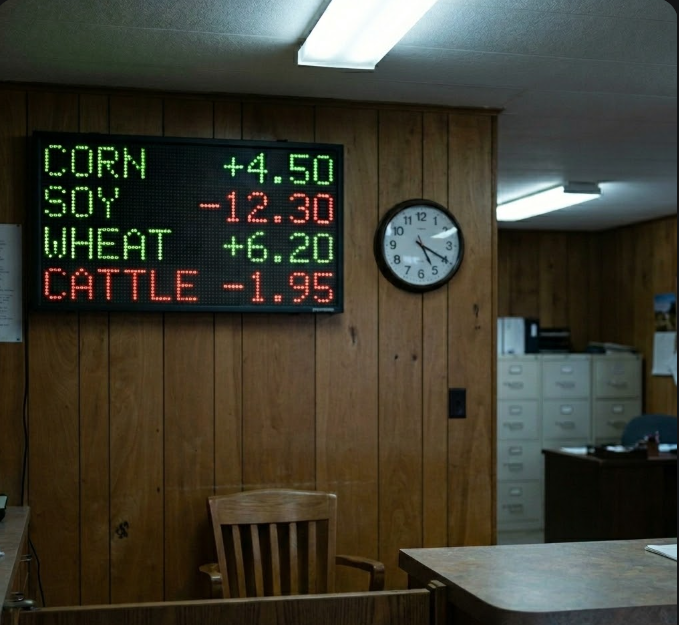
Professional traders with teams of analysts and decades of experience get it wrong regularly. The idea that a producer — managing an operation, watching weather, handling equipment, raising a family — should be able to pick the top of the corn market is not realistic. And yet that’s the standard most farmers hold themselves to.
The real cost of market timing isn’t the missed rally. It’s what the obsession with timing does to your decision-making. Watching prices every day creates a kind of paralysis — too afraid to sell on the way up because it might go higher, too afraid to sell on the way down because it might come back. The result is that many producers sell at harvest by default, not by plan.
Sound Familiar?
Patterns we see that cost producers the most
These aren't failures of knowledge — they're predictable psychological patterns. Recognizing yours is the first step to breaking it.
Trap 01
Waiting for One More Dollar
Prices are good — maybe the best in years. But they’ve been moving up, and it feels like there’s more to come. So you wait. And wait. And then the USDA report hits and prices drop $0.60 in a session.
Trap 02
Selling Into the Panic
Prices have been falling for two weeks. The news is bad, the charts look worse, and your neighbor just sold everything. So you sell — right at the bottom, just before the market reverses.
Trap 03
Harvest Default
No sales were made pre-harvest. The bin fills up, the loan is due, the elevator calls. Grain gets sold at whatever the market is offering that week — not because it’s a good price, but because the calendar ran out.
A Different Way to Think About This
The Goal Isn't to Time the Market. It's to Make Timing Irrelevant.
The effective grain marketing approaches don't require you to predict what the market will do. They're built to produce acceptable outcomes regardless of whether you're right or wrong about direction.
01
Price in Layers, Not All at Once
Selling 20–25% of expected production at a time — spread across February, April, June, and harvest — means you’ll never sell it all at the top, but you’ll never sell it all at the bottom either. You’re averaging into the year instead of betting on a single moment. The psychology shifts from “did I get the best price?” to “did I execute my plan?”
02
Use Options to Stay in the Market After You've Priced
One of the biggest fears about selling early is missing a rally. Put options solve this — they let you lock in a floor price while keeping the ability to benefit if prices continue to rise. You’ve already protected downside, so you can watch a rally without the anxiety of an unpriced position. While there can be no guarantee against loss options strategies cap your downside loss to the premium paid, while preserving your ability to benefit if cash prices improve.
03
Let Your Cost of Production Set the Calendar
When prices are above your breakeven by a meaningful amount, that’s your signal — not a chart pattern, not a neighbor’s opinion, not a gut feeling. A predetermined trigger based on your actual profitability turns a subjective, emotional decision into an objective one. The market tells you when, not the other way around.
04
Separate the Marketing Decision From the Storage Decision
Many producers treat “when to sell” and “when to move the grain” as the same question. They’re not. You can price futures in February and still deliver in June. Separating the pricing decision from the physical delivery decision gives you more flexibility — and more time to wait for a strong basis without leaving your price exposure open.
A Plan Beats a Prediction
Every Time.
You don't need to call the market. You need a strategy that produces good outcomes whether you're right or wrong. The goal is a marketing approach that produces acceptable outcomes across a range of price scenarios — not one that depends on being right about direction.
OUR TECHNOLOGY
Stop Watching Prices.
Start Reading Signals.
Timing decisions get easier when you're looking at the right information — not just the price, but the market forces shaping where prices are likely to go next.

AI-Powered Market Data
Numbers.ag
COT data shows what commercial hedgers — the most informed participants in the market — are doing with their positions. When commercials are aggressively buying, that’s a different signal than when they’re selling. Numbers.ag makes that data readable for producers, not just traders.

Local Basis Intelligence
Grain Basis
Sometimes timing isn’t about the futures price at all — it’s about basis. When local elevators are paying strong basis, that’s often the better signal to act than anything happening in Chicago. Grain Basis shows you local bid strength across your region in real time.

LATEST ARTICLES
Check out the latest industry articles

Corn Fund Liquidation Accelerates After October WASDE
Corn Fund Liquidation Accelerates After October WASDE
Corn Managed Money Net Long Falls Before October WASDE
Corn Managed Money Net Long Falls Before October WASDE
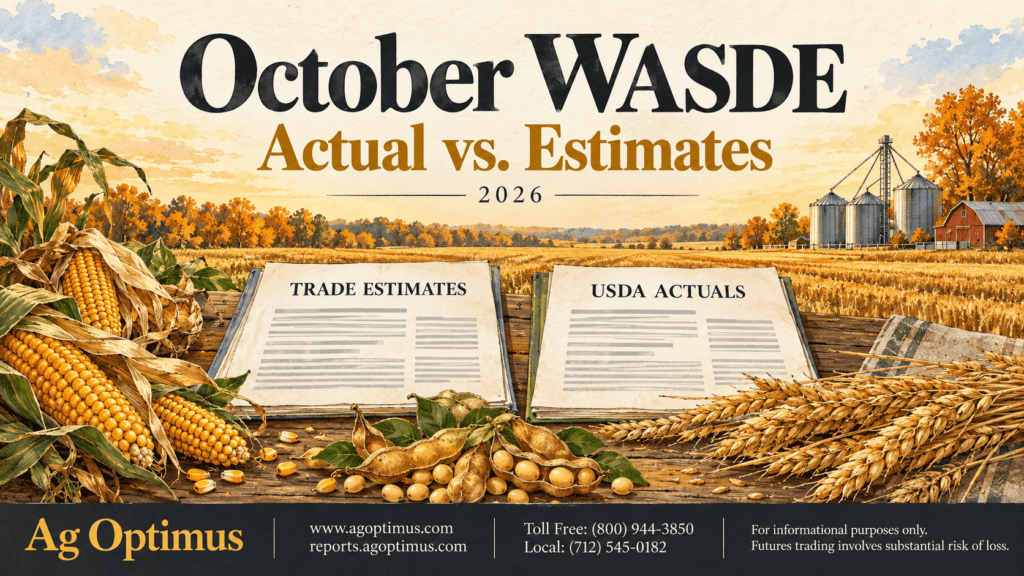
October WASDE Actual vs. Estimates: Full Scorecard
October WASDE Actual vs. Estimates: Full Scorecard
October WASDE: Corn Carryout Jumps to 1.849 Billion Bushels
October WASDE: Corn Carryout Jumps to 1.849 Billion Bushels
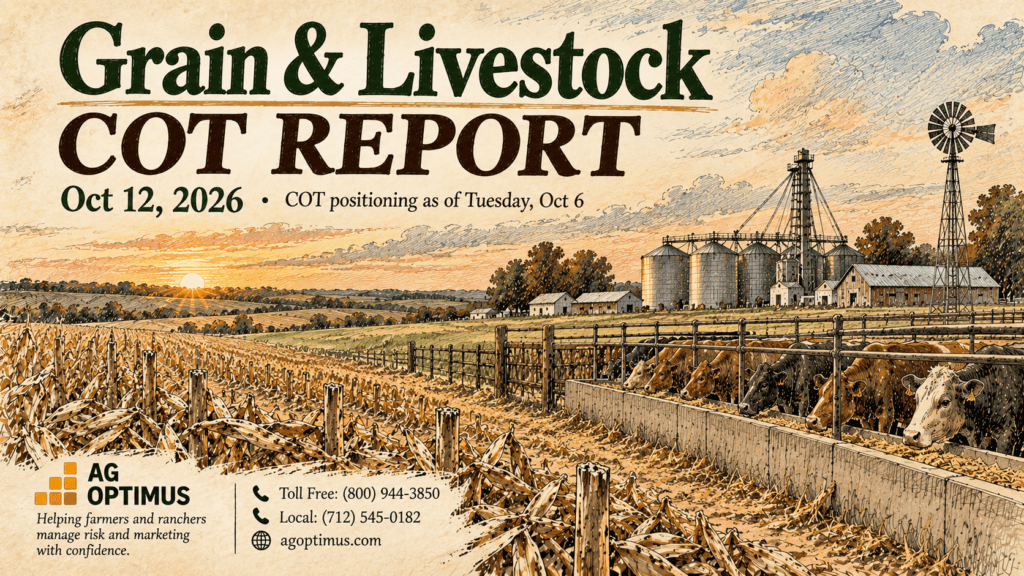
Grain & Livestock COT Report — Oct 5, 2026 · COT positioning as of Tuesday, Sep 29, 2026
Grain & Livestock COT Report — Oct 5, 2026 · COT positioning as of Tuesday, Sep 29, 2026
FAQs
Questions about grain marketing timing, building a marketing plan, and how to stop letting the calendar make your pricing decisions for you.
Seasonally, corn and soybean prices tend to be stronger in the spring and early summer before new crop harvest pressure builds. But seasonal patterns are averages — any given year can break them completely. A better approach than hunting for the seasonal peak is setting a price target based on your cost of production, then pricing incrementally when the market reaches it. That way you’re capturing a profitable price, not chasing a perfect one.
A grain marketing plan is a written strategy that answers the key questions before you’re under pressure to answer them: What’s my breakeven? What price do I need to be profitable? What percentage of my crop will I price at each trigger? When will I price by default if prices don’t reach my target? Having those answers in advance removes most of the emotion from the decision — you’re executing a plan, not reacting to a market.
Scale-in pricing means committing to sell a set percentage of your expected production at regular intervals throughout the marketing year — for example, 20% by March 1, another 20% by May 1, and so on. Each tranche gets priced at whatever the market is offering at that date, regardless of whether it feels like the right time. Over time this approach averages your price across the marketing season and removes the single-bet decision that causes so much stress and regret.
This is one of the most common things we hear — and it’s worth separating the decision from the outcome. If you sold at a profitable price that covered your cost of production and met your financial goals, that was a good decision. The market going higher afterward doesn’t make it a bad one. The goal isn’t to maximize price — it’s to protect margin. Measuring your marketing against the theoretical peak is a game you’ll always lose.
Yes — and in many years, pre-planting prices are among the strongest of the marketing year. The trade-off is production risk: if your crop comes in short due to weather, you’ll need to cover a futures position without the physical grain to back it. Most experienced marketers manage this by limiting pre-planting sales to a conservative percentage of expected production — typically 20–30% — and using options rather than futures to keep flexibility if yields disappoint.