
No pressure, no jargon — just a conversation about your operation.
BASIS RISK
Basis: The Part of the Price Nobody Explains Clearly
You can get the futures price right and still lose money on the deal. The difference between what Chicago says corn is worth and what your elevator actually pays is called basis — and it moves in ways that can quietly erase a good marketing decision.
Talk to a Broker
We'll reach out within one business day. All conversations are confidential.

You're Not the Only One Who Nodded Along
Most farmers have sat across from an elevator merchandiser or a broker and heard the word “basis” used as if it’s self-explanatory. And most farmers have nodded — because asking feels like admitting something they should already know.
Here’s the thing: basis is genuinely underexplained. The industry treats it as assumed knowledge, which means a lot of producers are making marketing decisions without fully understanding one of the most significant variables in their net price. That’s not a character flaw. It’s a gap the industry created.
The Plain English Version
What Basis Actually Is
One formula. Once you see it visually, it clicks.
Cash Price
$4.45
What your elevator
actually pays you
actually pays you
=
Futures Price
$4.80
December corn on
the Chicago exchange
the Chicago exchange
+
Basis
−$0.35
Your local elevator's
discount to futures
discount to futures
Same futures price. Different basis. Completely different check. Here's what that looks like on 10,000 bushels.
Weak Basis Year
Elevator A in October — Harvest Pressure
December Futures$4.80
Local Basis−$0.65
Cash Price/bu$4.15
Bushels10,000
Total Received$41,500
Strong Basis — Same Futures Price
Elevator B in February — Post-Harvest
December Futures$4.80
Local Basis−$0.20
Cash Price/bu$4.60
Bushels10,000
Total Received$46,000
$4,500 difference on the same 10,000 bushels — with the exact same futures price. That's what basis risk looks like in practice. And most producers never track it closely enough to see it happening.GrainBasis was developed as a companion platform for grain producers. AgOptimus makes it available to clients as an independent data tool.
Why It Matters
Basis Isn't Random — It Moves
for Specific Reasons
Once you understand why basis moves, it stops feeling unpredictable. You start to see patterns — and opportunities.

Local Supply & Demand
When every farmer in the county is hauling corn to the elevator at the same time — typically right after harvest — the elevator doesn’t need to pay up to attract grain. Basis weakens. When storage is tight and demand is high, they do. Basis strengthens. It’s local economics, not a Chicago decision.

Transportation & Carrying Costs
Basis reflects the cost of moving your grain from your local market to the delivery point the futures contract references. When rail or truck freight rates rise, basis weakens. When storage is readily available and markets are in “carry,” basis can firm up as elevators compete for grain to carry forward.

Time of Year
Basis follows seasonal patterns that repeat fairly predictably year to year. Harvest-time basis tends to be weak as grain floods the market. Post-harvest and pre-planting basis often strengthens as elevators need to attract stored grain. Understanding these patterns helps you sell at the right time — not just the right futures price.
You Asked the Right Question
by Being Here.
Most producers never dig into basis until it costs them money they didn't see coming. You're ahead of the curve. Let's talk about what your local basis picture looks like right now.
Turning Knowledge Into Action
How to Stop Losing Money
on Basis You Didn't See Coming
1
Track basis at your local elevators — not just futures
The futures board tells you one number. Your elevator tells you another. The gap between them is where your actual net price lives. Track it over time and patterns emerge.
2
Compare bids across elevators before you sell
Basis varies between elevators — sometimes by $0.10–0.20/bushel for no obvious reason. On 50,000 bushels, that's $5,000–$10,000 for making one phone call. Most producers only call one elevator.
3
Separate the basis decision from the futures decision
You can lock in a futures price in February and wait for a stronger basis before physically delivering in June. The two decisions don't have to happen at the same time — and often shouldn't.
4
Know your historical basis range for your area
If basis at your elevator historically runs between -$0.25 and -$0.55, and it's currently at -$0.20, that's historically strong. That's useful information. Without history, you have no reference point.
Basis questions are exactly what broker conversations are for. If you've always nodded along, it's time to ask directly.
Talk to a Broker →Our Technology — Local Basis Intelligence
GrainBasis
GrainBasis was built specifically for this problem. It pulls live elevator bids from locations across your region and shows you exactly where basis is strong, where it's weak, and how it's trending — so you're not pricing blind.
Real-time elevator bids across your region, updated continuously
Side-by-side basis comparison across multiple delivery points
Historical basis data so you know whether today's bid is strong or weak by local standards
Works alongside your futures position — see the full net price, not just the board
Who This Affects Most
Basis Risk Hits Differently
Depending on Your Operation
Grain farmers face basis risk as a cost eroding their net price. Grain elevators face it as an existential business risk. Same concept — completely different stakes. For producers, basis is the final variable that determines whether a marketing decision that looked good on paper actually was good. Tracking local basis — and knowing when it’s historically favorable — is the difference between a smart sale and an unlucky one. For elevators, the entire margin model lives in the spread between what they pay producers and what they receive from end buyers. When the market inverts, carry disappears, or basis collapses unexpectedly, it’s not just one transaction — it’s the whole book. Basis management isn’t optional at this level.
LATEST ARTICLES
Check out the latest industry articles

WASDE Sep 2026 Actual vs. Estimates
WASDE Sep 2026 Actual vs. Estimates

Why a Weather Forecast in Brazil Can Move Your Soybean Bid
Why a Weather Forecast in Brazil Can Move Your Soybean Bid
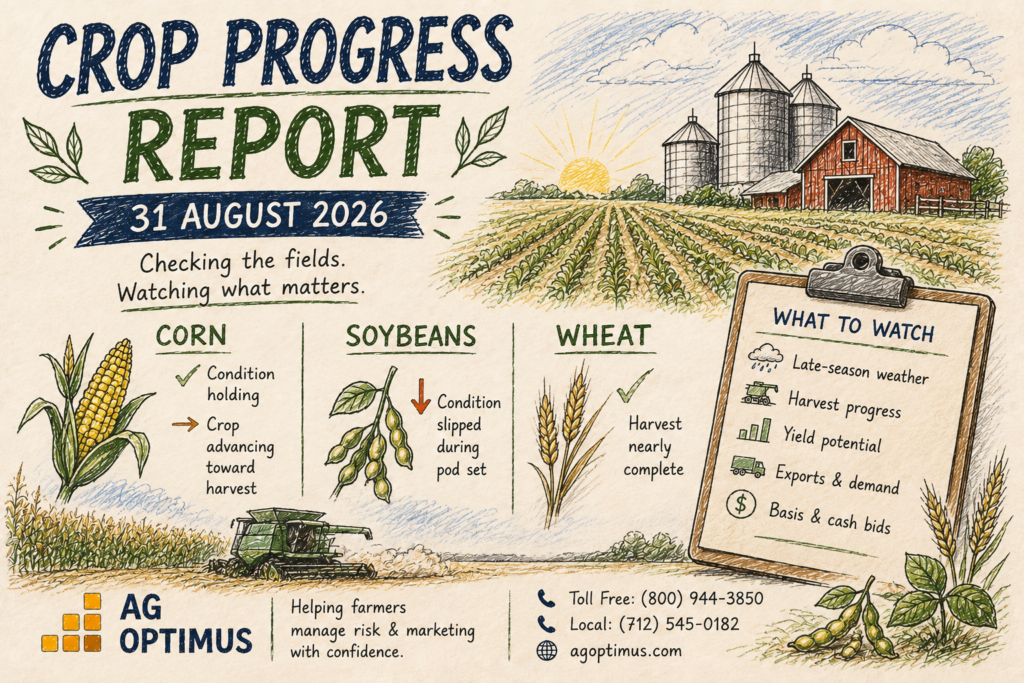
USDA Crop Progress Audit — Aug 31, 2026 | Corn 57%, Soybeans 58%
USDA Crop Progress Audit — Aug 31, 2026 | Corn 57%, Soybeans 58%
FAQs
The questions producers ask when they finally get comfortable enough to ask — no judgment, just straight answers.
How is basis calculated?
Basis is simply your local cash price minus the nearby futures price. If your elevator is bidding $4.45 for corn and December futures are trading at $4.80, your basis is -$0.35. A basis of -$0.35 is commonly written as “35 under December.” When basis is negative (which it almost always is for grain producers), it means your local market is at a discount to Chicago. A stronger (less negative) basis means a higher net price for the same futures level.
Why is basis almost always negative?
Because the futures price represents delivery at a specific location — typically a terminal market or export hub — and your grain isn’t there yet. The negative basis covers the cost of getting it there: transportation, handling, storage, and the elevator’s profit margin. The farther you are from major transportation infrastructure, the weaker your basis tends to be. An elevator near a river terminal or major rail hub typically offers stronger basis than one in a remote inland county.
What is a basis contract?
A basis contract lets you lock in the basis level today while leaving the futures price open. It’s the opposite of selling futures — you’re fixing the local market premium or discount but keeping exposure to the futures price. This is useful when basis is historically strong but you think futures prices might rally further. You capture the favorable basis now and set the futures component later, when conditions are right.
Can I use my futures hedge but wait for better basis before delivering?
Yes — and this is one of the most powerful strategies available to producers with on-farm storage. You sell futures in February to lock in a profitable price, then store the physical grain and wait for basis to strengthen post-harvest. When basis improves, you deliver the grain and buy back your futures position. The net result is a higher cash price than you could have received by doing both at once. It requires storage capacity and the ability to manage the futures position, but for operations with those tools, it can be significantly more profitable than selling everything at harvest.
How do I know if today's basis is good or bad?
You need historical context for your specific location. A basis of -$0.25 could be excellent at one elevator in one region and completely typical at another. The only way to know is to track what basis has been at your local elevators over the past several years and understand the seasonal pattern. Grain Basis gives you that historical data alongside current bids — so when you see a bid come through, you can immediately see whether it’s historically strong, average, or weak for that time of year at that location.