TL;DR: The 30-Second Summary
- The Myth: “My bins are paid for, so storing grain is free.”
- The Reality: When interest rates are high, holding grain can carry a real cost every day in the form of opportunity cost.
- The Math: If you carry an operating note, holding corn can cost roughly 3 cents per bushel, per month in interest and shrink, depending on your rate and conditions.
- One Approach: Rather than hold and hope, some producers use a “sell & defend” approach: sell the cash grain to stop the interest cost, then re-establish potential upside with a call option, accepting the premium paid as the cost and maximum risk of that option.
It is mid-December. The combine is parked, the bins are full, and the fans are off — time to think about the cost of carry.
If you are like many producers we talk to at AgOptimus, your marketing plan right now may be simple: “Wait.”
You figure, “I own the bins, so the storage is free. I can sit on this corn until it reaches a higher price.”
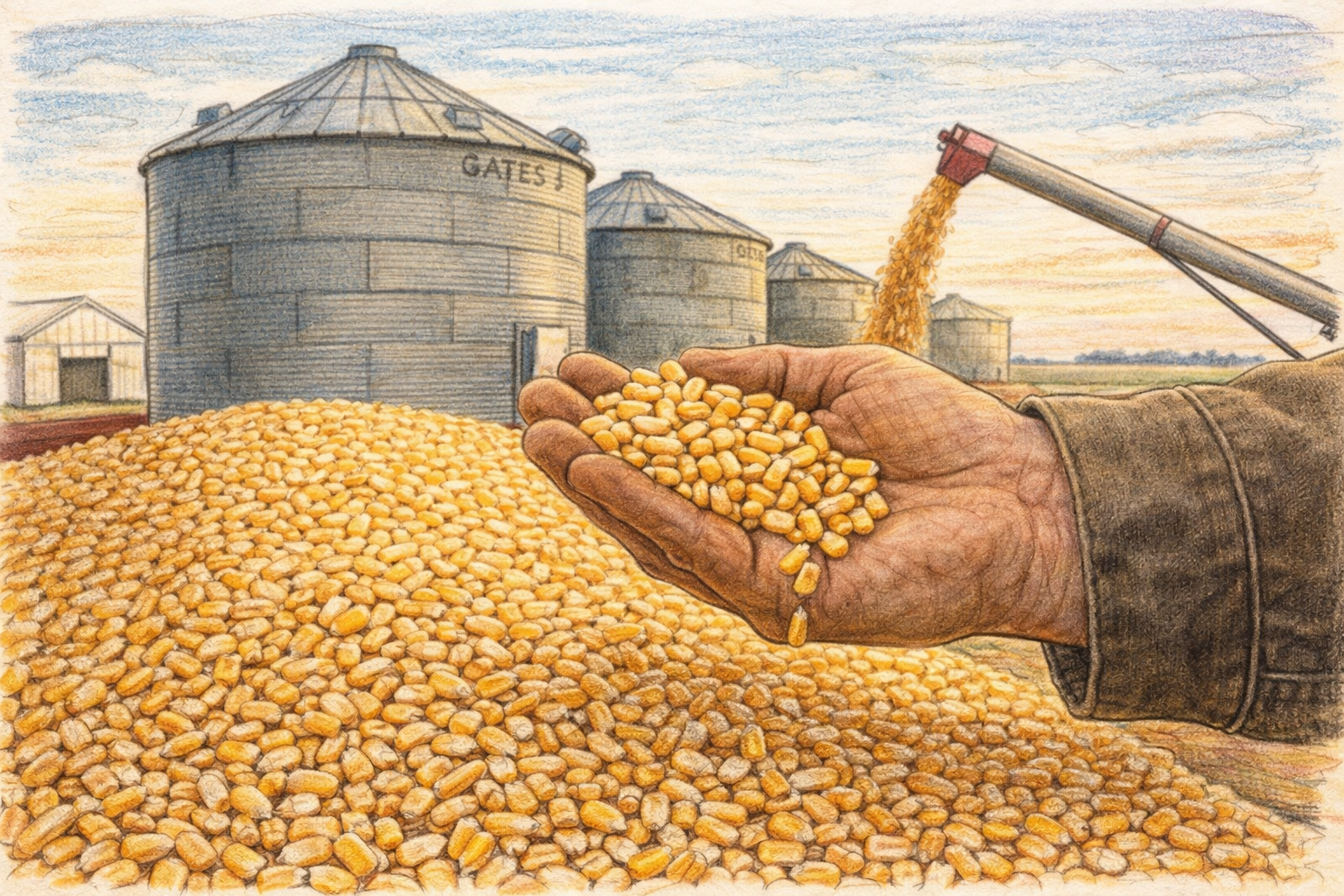
But here is a hard truth worth considering: a grain bin is not a bank vault. Stored grain can quietly lose value over time.
That “free” storage may be more expensive than it looks. With interest rates where they are, costs can accumulate over time, and on many operations, every day grain sits in the bin is a day you may be paying to hold it.
The “Free Storage” Myth Explained
First, let’s clear up the definition. When we talk about the cost of holding grain, we are talking about opportunity cost.
Opportunity cost: the money you potentially lose by having cash tied up in grain instead of in the bank or paying down debt.
Large commercial grain handlers tend to manage this carefully. They generally do not hold grain unhedged because the cost of carry can erode margins. Yet many producers overlook this invisible cost until late in the season.
Show the Money: The Real Cost of Waiting
Let’s look at a hypothetical example of the math. If you are holding corn with a $4.20 cash bid and you have an operating note at 7%, time is working against you.
Here is an illustrative breakdown of what that “free” bin could be costing you. Your actual numbers will vary with your interest rate, local conditions, and grain quality:
| Expense | Cost per Month | Cost for 6 Months |
|---|---|---|
| Interest Opportunity (7% on $4.20) | 2.5 cents/bu | 15 cents/bu |
| Shrink & Quality Risk | 0.5 cents/bu | 3 cents/bu |
| Total Estimated Cost to Wait | 3 cents/bu | 18 cents/bu |
What this means: in this example, the board would need to rally about 18 cents over six months just to offset the estimated carrying cost. If the market stays flat, the carrying cost is not recovered. This is an illustration, not a prediction of market direction.
One Approach: The “Sell & Defend” Strategy
Rather than relying on hope, some producers use an approach that addresses interest costs while maintaining exposure to a potential rally. The idea is to separate the cash-sale decision from the market opinion.
Step 1: Address the Carrying Cost
We track your local elevator’s historical basis patterns and current bids. When the market strengthens, we make every effort to help you identify a reasonable time to sell the physical grain. We cannot predict basis or price movements, and outcomes vary.
Step 2: Re-Establish Upside With a Call Option
But what if corn rallies after you sell? If you want to keep exposure to that potential move, one tool is a call option.
A call option gives you the right, but not the obligation, to establish a position at a set price for a limited time. You pay a one-time premium, and that premium is the most you can lose on the option. In some situations, that premium may be comparable to — or less than — the interest you would otherwise pay to carry the grain, though this is not guaranteed and depends on market conditions.
- Estimated cost to hold physical grain (this example): about 18 cents/bu in carrying cost.
- Illustrative call option premium: a one-time premium that is fully at risk if the option expires worthless.
The idea: by selling the cash grain, you eliminate interest costs and storage costs, while the call option maintains exposure to a possible rally at a known, limited premium. Whether this works out favorably depends on the market, and the option premium can be lost in full.
Frequently Asked Questions
Is it better to store or sell corn right now?
It depends on your cost of carry. If your interest cost to hold the grain is higher than the basis appreciation you reasonably expect, selling the cash grain may make sense. There is no single right answer; it depends on your interest rate, local basis, and cash-flow needs.
What exactly is a call option in simple terms?
A call option gives you the right, but not the obligation, to establish a position at a specific price for a limited time. If prices rally above your strike, the option can gain value. If prices do not, the option can expire worthless, and your loss is limited to the premium you paid.
Does on-farm storage ever make sense?
Yes. Storage can make sense when the futures market is paying you to wait (a large “carry”) or when local basis is historically weak and reasonably expected to improve. These conditions vary, and we track these signals as part of our work with producers.
How do I re-own my grain after selling it?
You do not repurchase the physical bushels. You re-establish price exposure by buying a futures contract or an option on the Chicago Board of Trade. This keeps exposure to a price rally without the cost of storing physical grain, while adding the risks associated with futures and options positions.
Stop Guessing. Build a Plan.
The market does not account for your breakeven, and carrying costs can erode equity over time if left unmanaged.
If you would like to review your options, you generally have two paths:
- Continue storing and waiting while interest and shrinkage accrue against your margin.
- Talk with us about how a “sell & defend” approach might fit your operation, including the risks involved.
To discuss whether this approach fits your operation, contact AgOptimus for a consultation. We will walk through the estimated carrying cost and the option strategies that may apply to your situation.
Disclaimer: AgOptimus is a registered DBA of Optimus Futures LLC, an Independent Introducing Broker. Trading futures and options involves substantial risk of loss and is not suitable for all investors. Options buyers risk the entire premium paid. The examples above are hypothetical and for educational purposes only; they are not predictions of market direction and do not guarantee any result. Past performance is not necessarily indicative of future results. You should evaluate any strategy against your own financial condition and risk tolerance.