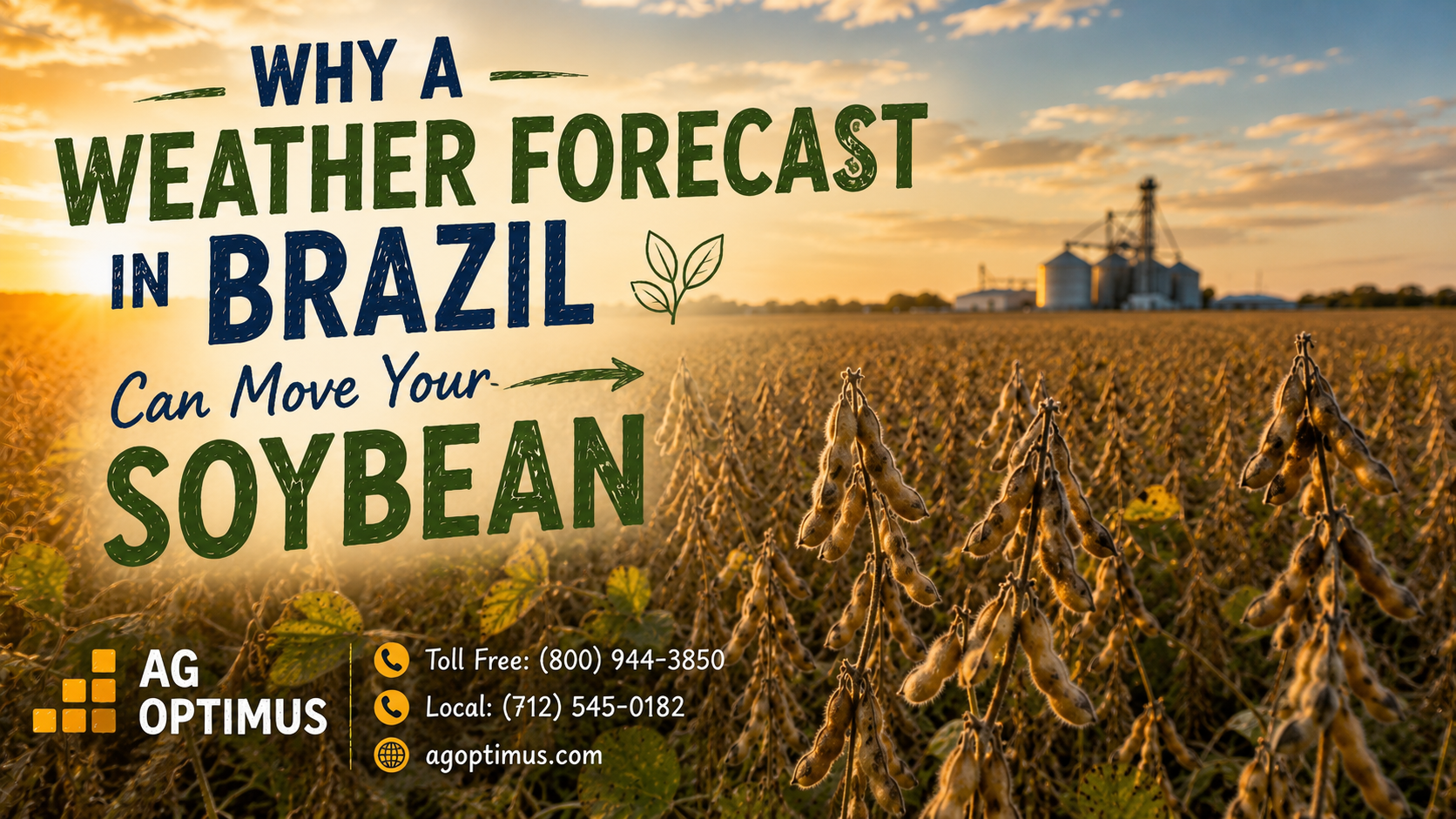
A weather forecast in Brazil does not change the number of soybean acres on your farm. It can still change what an elevator or processor is willing to bid for your beans.
If timely rain improves Brazil’s crop outlook, a weaker Brazilian real makes its exports cheaper, or Brazilian ports move beans efficiently, China and other importers have more alternatives to U.S. soybeans. If Brazil’s crop, harvest, logistics, or export pace encounters trouble, global buyers may need more U.S. beans. That can affect Chicago soybean futures, U.S. export demand, and—together with local supply and demand—your cash bid.
The important point is not that every Brazilian forecast moves the market. The useful question is whether the forecast changes the world’s supply of exportable soybeans, the cost of delivering beans to a buyer, or the timing of demand during the U.S. export window.
Brazil is the United States’ largest soybean-export competitor, and China is the dominant buyer in the world soybean market. When Brazilian weather changes expected production, harvest timing, or export capacity, it can change the number of soybeans available to China and other buyers. That can affect soybean futures, U.S. export demand, and sometimes local basis. USDA Economic Research Service analysis found China was the destination for 57.6% of U.S. soybean exports and 70% of Brazilian soybean exports in the 2021/22 marketing year used in its analysis.
Your soybean bid has two parts
The cash price at an elevator, ethanol plant, processor, or export terminal is commonly expressed as:
=
Futures price
+
Local basis
Brazil can influence both parts, but not in the same way.
A Brazil-weather event can move futures quickly. Basis may move later, less, more, or even in the opposite direction. A large local crop, full elevator space, weak processor margins, or expensive transportation can keep basis weak even when Chicago futures rise (see what to do when basis blows out at harvest). Conversely, a processor needing beans may bid aggressively even when futures are soft.
Farmer takeaway: Do not assume a move in Chicago soybean futures will pass through penny-for-penny to your cash bid. Separate the futures decision from the basis decision. Corn Basis Explained: Cash vs. Futures walks through how the two parts move independently.
The Brazil–China–United States triangle
The global soybean market is not a list of every country. For a U.S. farmer, the central relationship is a triangle:
|
Brazil
changes competing soybean supply and export availability.
|
China
changes world import demand and chooses among origins.
|
The United States
competes to supply beans when its delivered price, timing, quality, and logistics work for the buyer.
|
USDA research describes China as accounting for more than 60% of world soybean imports, while Brazil and the United States supply most global soybean exports. USDA Foreign Agricultural Service data list China as the largest reported destination by value for U.S. soybean exports in 2025, ahead of the European Union.
The simple mechanism
Brazil’s soybean calendar: when weather matters most
Brazil is a large country with multiple production regions, planting windows, and harvest schedules. The exact weather impact depends on where the forecast occurs, how much acreage is affected, soil moisture, crop stage, and whether conditions are unusual for that time of year.
|
September–November
Planting
|
Are planting rains arriving on time? Are farmers planting at a normal pace?
Delays can create uncertainty about acreage establishment, yield potential, and the timing of Brazil’s harvest and export program
|
|
December–February
Yield formation
|
Does weather support flowering, pod set, and seed fill?
Broad heat or moisture stress during reproductive stages can affect expected output and increase concern about competing supply
|
|
February–May
Harvest & logistics
|
Is harvest moving normally? Are rain, roads, barge systems, rail, and ports allowing export flow?
A slow Brazilian harvest or export program can extend the period when buyers look to the United States
|
|
June–August
Export competition
|
How aggressively is Brazil selling and shipping?
Large Brazilian shipments can compete with U.S. exports and influence world buyers’ alternatives
|
|
September–January
U.S. export window
|
Are Chinese and other buyers shifting toward new-crop U.S. supplies?
This is typically the period when the U.S. export program has its best seasonal opportunity before Brazil’s next harvest becomes available
|
A forecast matters most when it occurs in a major soybean region during a yield-sensitive stage or when it threatens harvest and export logistics. One isolated weather headline is not the same thing as a national production problem.
Five ways Brazil can affect U.S. competitiveness
Rain during Brazil’s planting season is not automatically bullish or bearish for U.S. soybeans. The market first asks whether it enables normal planting or creates delays. A meaningful delay can affect crop-development timing and may also affect the timing of Brazil’s next export season. Good rains that support broad, timely planting generally reduce uncertainty about Brazilian supply.
Heat and dryness matter more during reproductive periods than during less sensitive growth stages. If weather threatens pod set or seed fill across a large area, traders may reassess Brazilian yield potential and the amount of soybeans available to export.
Brazil can have a large crop and still face complications moving it. Harvest rain, muddy roads, limited truck availability, barge constraints, rail disruption, long port lineups, or high freight can delay access to export channels.
This distinction matters because the global market responds to available supply, not only paper production. A crop that exists but cannot move efficiently may temporarily make U.S. beans more competitive.
A farmer does not need to trade currencies to understand why they matter. Soybeans compete in a global market priced largely in U.S. dollars. If the Brazilian real weakens against the U.S. dollar, Brazilian sellers may receive more local-currency revenue from a given dollar export price. That can keep Brazilian offers competitive even without a change in crop size.
Currency is not a stand-alone price forecast. It works alongside production, farmer selling, inland transportation, ocean freight, port efficiency, quality, and buyer demand.
The United States is usually most competitive after its fall harvest and before Brazil’s new crop becomes broadly available for export. That seasonal window is not guaranteed. A large U.S. crop, weak basis, high freight, a strong dollar, or slow Chinese buying can limit demand. But a delayed Brazilian crop or constrained Brazilian logistics can extend the U.S. opportunity.
China is the demand side of the equation
Brazil weather matters because a large share of global soybean demand must decide where to buy. China is the central buyer in that decision. USDA ERS found that China was the destination for 57.6% of U.S. soybean exports and 70% of Brazilian exports in the marketing year examined in its analysis.
China’s buying behavior can change when any of the following changes:
- Soybean-crush margins and processor profitability.
- Hog and poultry feed demand.
- Government reserve purchases or releases.
- Import policy, tariffs, inspections, or trade access.
- The delivered price of U.S. versus Brazilian beans.
- The timing of available supply from each origin.
A large Chinese purchase announcement can be important, but it is more useful when it is confirmed by sustained export-sales pace, shipment activity, and repeated buying. A single sale may be a headline; a series of sales can signal a demand pattern.
Brazil does not compete alone
Brazil is the main competitor in the U.S. soybean-export story, but it is not the only country that matters.
Argentina affects the soybean complex through its large processing sector and its role in soybean meal and oil trade. Argentine crop size, export taxes, currency policy, farmer selling, and crush margins can alter global supplies of soybean products. Those product markets influence crush economics and, in turn, the value processors can justify paying for raw beans. (If you run a crush or processing operation, our commercial hedging desk works with that exposure directly.)
The European Union and parts of Southeast Asia matter as destinations for soybeans and soybean meal, but their influence on daily U.S. soybean pricing is generally less direct than China’s. USDA FAS provides monthly global analysis of oilseed production, consumption, trade, and stocks; it forecast global soybean exports at 189 million metric tons for 2026/27 in its May 2026 outlook.
Other South American suppliers—including Paraguay, Bolivia, and Uruguay—can matter at the margin, particularly when a larger exporter has a production or logistics problem. But they generally do not deserve equal attention in a farmer’s daily market checklist.
The hierarchy is the point:
Why the board and basis may disagree
A Brazil-weather story may affect Chicago futures but have a smaller, delayed, or different effect on your local cash bid.
Your elevator’s bid is still local. Nearby crop size, harvest pace, storage capacity, processor demand, barge freight, rail capacity, and delivery needs may matter more to basis on a given day than the weather in Brazil. Our crop marketing guide covers what to ask your elevator and when to ask it.
Before reacting to a weather headline, ask:
If the answer to the last question is no, it may be useful information—but it is not yet a reason to change a marketing decision. The same discipline applies to the risk this whole article describes — see managing basis risk.
Frequently asked questions
Why does weather in Brazil affect U.S. soybean prices?
Brazil is a major competitor to the United States in the soybean export market. If Brazilian weather threatens planting, yield, harvest, or export movement, world buyers may need more U.S. soybeans. If Brazil’s crop outlook improves and exports move efficiently, buyers have more alternative supply. That can affect soybean futures, U.S. export demand, and potentially local basis.
Does rain in Brazil always move soybean prices?
No. Rain matters only when it is timely or untimely enough, widespread enough, and located in a major production region during a sensitive crop stage. The market also considers soil moisture, planting pace, the forecast beyond a single day, production estimates, Brazilian export logistics, currency, and Chinese demand. A weather forecast is not automatically a crop loss or a price signal.
When does Brazil weather matter most for U.S. soybean farmers?
Brazilian weather matters most during planting (roughly September through November), reproductive development and yield formation (December through February), and harvest and export movement (February through May). Exact timing varies by region and planting date. Delayed Brazilian harvest or exports can be especially important during the U.S. fall and early-winter export window.
How does Brazil affect my local soybean basis?
Brazil does not directly set your local basis. Basis reflects nearby elevator and processor demand, local harvest flow, transportation, storage availability, and regional export access. Brazil can affect basis indirectly if its crop or shipment pace changes demand for U.S. exports, but basis can move differently from Chicago futures.
What is the difference between soybean futures and my cash bid?
Futures represent the broader market’s expectations for global supply, demand, trade, and risk. Your cash bid combines futures with local basis. Brazil weather events may move futures first, while the cash-bid response depends on local supply, processor demand, transportation, storage, and delivery conditions.
Why does China matter to both U.S. and Brazilian soybean farmers?
China is a central buyer in the global soybean market. USDA ERS reported that China was the destination for 57.6% of U.S. soybean exports and 70% of Brazilian soybean exports in the marketing year used in its analysis. Changes in Chinese crush demand, livestock-feed demand, policy, import pace, or the delivered price of beans can change which origin buyers prefer.
Can a weaker Brazilian real affect U.S. soybean prices?
Yes. A weaker Brazilian real can make Brazil’s dollar-denominated export offers more competitive even if crop prospects are unchanged. That may make it harder for U.S. exporters to win business. Currency is only one factor; crop size, freight, port capacity, quality, timing, and Chinese demand remain important.
What should I watch besides a Brazil weather forecast?
Watch Brazilian planting and harvest progress, crop-condition information, production estimates, farmer selling, port lineups, export pace, freight, and the Brazilian real. Then look for confirmation in U.S. weekly export sales and shipments, Chinese buying, futures spreads, and—most importantly for your cash decision—your local basis and elevator or processor bids. Our crop marketing desk can help you track basis at the elevators you actually deliver to.
What to watch: a producer checklist
Bottom line
Brazil matters because it changes the alternatives available to the world’s soybean buyers. When Brazil can grow, price, and ship a large crop efficiently, the United States must compete harder for export business. When Brazilian weather, logistics, or currency reduce that advantage, U.S. soybeans can become more competitive.
The practical discipline is to look for confirmation. Do not make a marketing decision solely because a forecast says rain—or no rain—in Brazil. Ask whether the event affects a major producing area at a sensitive crop stage, whether it changes expected exportable supply or shipment timing, whether China’s buying behavior confirms the change, and whether your own futures and basis opportunities justify action.
Sources and methodology
- USDA Economic Research Service, Interdependence of China, United States, and Brazil in Soybean Trade. Explains the central Brazil–United States–China relationship and reports China’s share of U.S. and Brazilian soybean export destinations in the marketing year studied. USDA ERS report
- USDA Foreign Agricultural Service, Soybeans commodity data. U.S. soybean export data and major destinations. USDA FAS soybeans
- USDA Foreign Agricultural Service, Oilseeds: World Markets and Trade. Monthly global oilseed production, consumption, trade, and stocks context. USDA FAS oilseeds
- USDA Foreign Agricultural Service, Oilseeds: World Markets and Trade, May 2026. Global trade forecast context, including the 2026/27 soybean-export projection. USDA FAS report PDF
- USDA Economic Research Service, Corn and Soybean Production Costs and Export Competitiveness. Comparative framework for Argentina, Brazil, and the United States, including farm production, internal transportation, handling, and ocean-shipping costs. USDA ERS study
- Purdue University Center for Commercial Agriculture, U.S. and Brazil Soybean Competitiveness: Farm-Level Costs. Additional context on U.S.–Brazil competitiveness. Purdue analysis
Methodology: This is an evergreen educational guide. It explains market mechanisms rather than forecasting soybean prices or recommending a specific marketing action. Crop calendars are approximate because Brazil’s production timing varies by region, weather, and planting date. Statements about local basis are generalized; a producer should evaluate actual bids, delivery terms, historical basis, storage costs, cash-flow needs, and farm-specific production risk.
Disclosure: This material is for educational and informational purposes only. It is not a recommendation to buy or sell soybeans, futures, options, cash contracts, or any other financial product. Commodity futures and options involve substantial risk and are not suitable for every producer or investor. Past performance is not necessarily indicative of future results.
USDA does not endorse, certify, or approve this analysis, Ag Optimus, or Optimus Futures LLC, and the use of USDA data here does not imply any such endorsement. Optimus Futures does not maintain a research department as defined in CFTC Rule 1.71. Ag Optimus is a registered DBA of Optimus Futures LLC [NFA ID 0481133]. All trading decisions remain yours.