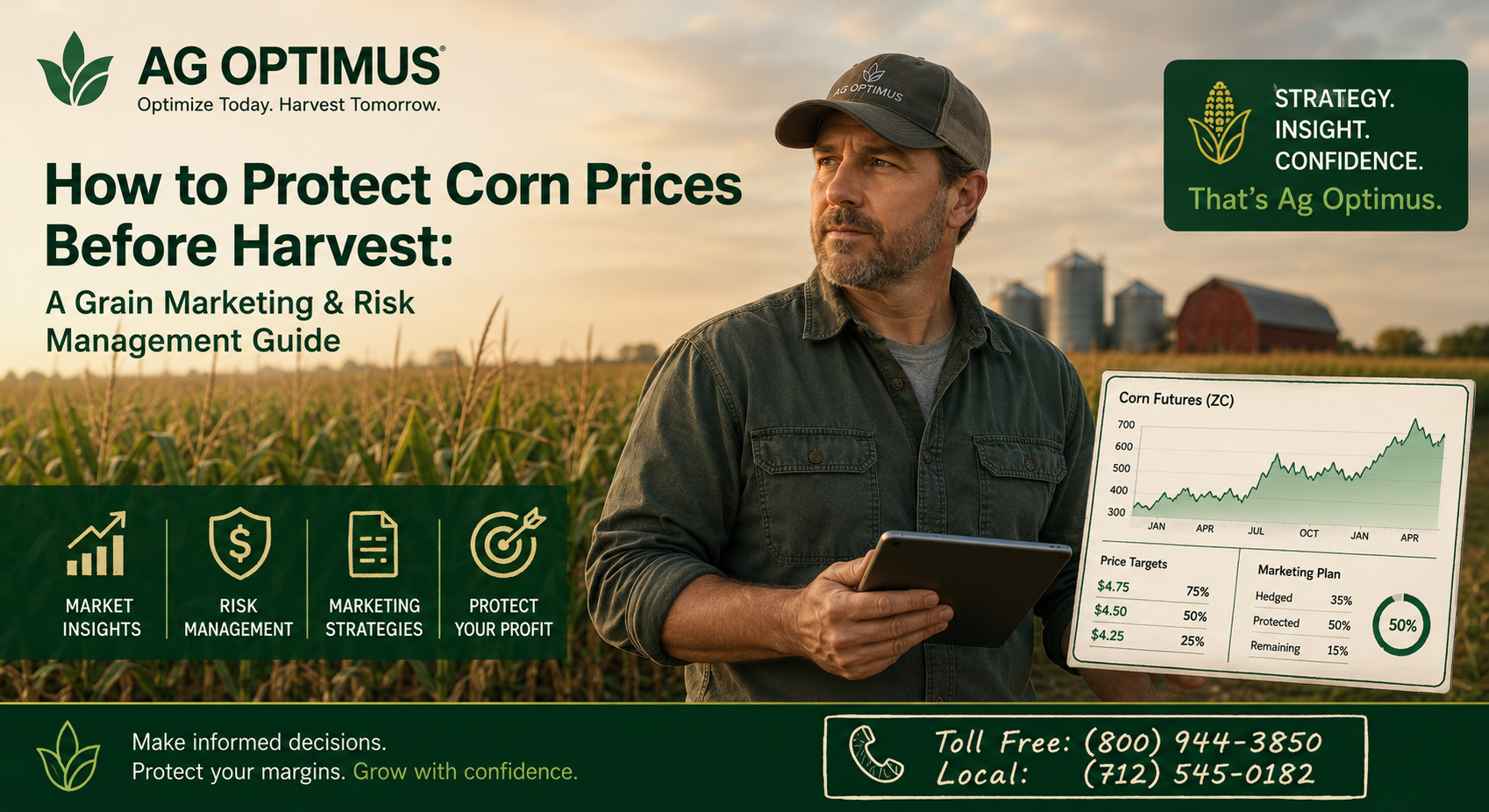
How to Protect Corn Prices Before Harvest: A Grain Marketing & Risk Management Guide
Learning how to protect corn prices before harvest comes down to one move: lock in a price for some of your projected crop before harvest, so a price drop can’t wipe out your margin. But the deeper lesson most successful producers learn is that grain marketing isn’t about predicting where corn prices go next. It’s about protecting profitability, preserving liquidity, and keeping flexibility.
This guide covers the full marketing decision — sell, store, or hedge — along with the tools, pricing, and the roles of crop insurance and working capital. It treats pre-harvest pricing as a discipline of agricultural risk management, not speculation, and shows where commodity brokerage services fit so you can protect working capital first and chase price second.
Key Takeaways for Commercial Producers
- Margin Protection: Commercial corn producers can secure profit margins before harvest using three primary risk management tools: short futures contracts, put options, and forward/Hedge-to-Arrive (HTA) contracts.
- Business First: Selling, storing, and hedging address different business needs — liquidity, flexibility, and price protection. Most operations combine them across the marketing year.
- Insurance Foundation: Revenue Protection (RP) sets the bushel volume to price, so your hedge and insurance work together.
- Conservative Sizing: To avoid the risk of buying back short bushels, base forward and futures commitments on a conservative 70% to 75% of your Actual Production History (APH).
- Working Capital: Liquidity matters as much as price. Even a sound hedge can create near-term cash needs, so weigh basis, storage, and margin exposure with the futures price.
- Professional Infrastructure: A brokerage like AgOptimus handles execution and margin calls, so you don’t have to watch prices every day.
Every Grain Producer Faces the Same Decision
Harvest is approaching, the combine is ready, and bids change every day. One question keeps coming back: should you sell the corn, store it, or protect it with a marketing strategy?
There’s no universal answer, because every operation is different. Some farms need quick access to cash to repay operating loans; others have storage and want flexible marketing options. Some want price protection while retaining upside potential; others simply want a plan they can explain to their lender and family members. The objective isn’t to predict the market — it’s to protect the business.
Start With Your Business, Not the Market
Every marketing decision starts with one number: your cost of production. Protecting that margin usually beats chasing an uncertain higher price.
Sell, Store, or Hedge?
These are business decisions, not trading decisions. Selling, storing, and hedging address different business needs:
| Decision | Primary Benefit | Primary Consideration |
|---|---|---|
| Sell cash grain | Immediate liquidity | No future pricing opportunity |
| Store grain | Marketing flexibility | Storage costs and basis risk |
| Hedge with futures | Price protection | Margin requirements |
| Buy put options | Price floor with upside | Premium cost |
| Forward or HTA contract | Simplicity | Delivery commitment |
Many commercial producers use more than one of these during the marketing year rather than relying on a single decision.
The Three Ways to Protect Corn Prices Before Harvest
When you decide to protect a price rather than sell outright, you have three main tools. Here’s how they compare at a glance:
| Sell Futures | Buy a Put Option | Forward / HTA | |
|---|---|---|---|
| Sets a price floor | Yes | Yes | Yes |
| Keeps upside if prices rise | No | Yes | No |
| Upfront cost | Margin deposit | Premium (lost if unused) | None |
| Margin calls possible | Yes | No | No |
| Delivery obligation | No | No | Yes |
| Best when | Firm price, can manage margin | Protection but prices may rise | Simplicity, reliable yield |
1. Sell Futures (Short Hedge)
You can establish a fixed selling price by entering a short position. A CME corn futures contract on the CBOT represents 5,000 bushels. Sell futures against grain you have or expect to harvest, and if cash prices fall, gains on the futures will offset the lower sale price, which effectively guarantees a price.
The tradeoff: a futures hedge fixes your price regardless of market direction. If prices climb after you hedge, you won’t capture that upside on the hedged bushels. Futures also require a margin account, so when prices rise you get margin calls for more cash, even if the increase in value of your crop covers those calls. Unmanaged against a physical position, futures can lose more than the initial margin deposit.
2. Buy a Put Option (Price Floor)
Buying a put sets a strike-price floor: you pay a premium for downside protection but keep the upside if the market rallies. A put lets you lock a minimum sale price for your corn while still selling at higher market prices if they come — a good hedge on fields with uncertain yield.
You pay a premium to set a floor. Your maximum loss is the premium. There are no daily margin calls, which is why a put often fits acres where your yield is least certain.
3. Forward Contract or Hedge-to-Arrive With Your Elevator
A forward contract sets the futures price and the local basis at signing. An HTA sets the futures price now and leaves the basis open to be set later.
These contracts are convenient because the elevator handles the mechanics, but they remove flexibility. A standard forward requires you to deliver a fixed quantity to the elevator, which is a problem if your yield falls short. Before committing, compare the elevator’s offer with direct futures pricing.
Do Margin Calls Mean a Hedge Is Failing?
No. A margin call is part of daily futures settlement and reflects market movement, not hedge failure. If you’re short and prices rise, your futures position shows a loss and requires margin, while your physical crop gains value — evaluate both together. It is the timing of cash flows, not a real loss, which is why you should prepare your margin exposure and operating line before you set up the hedge.
Storage Is More Than Extra Bin Space
Storage creates opportunity, but it also creates cost. Every month grain stays in the bin can add interest, insurance, aeration, shrinkage, and handling, plus the lost revenue from a delayed sale. Weigh those costs against potential basis improvement or future pricing opportunities. Use storage to hit a price or timing target, not as a substitute for a marketing plan.
Whether you have on-farm storage also changes the pre-harvest picture. With storage, you can split your price: secure the futures price now with options, then store the grain and set the basis later when it strengthens. Without storage, you’re more likely to move grain at harvest into a weaker basis window, which makes locking the futures portion early even more valuable.
Working Capital Matters More Than Most Producers Realize
A marketing plan influences not just grain prices but also operating loans, fertilizer purchases, machinery payments, family living expenses, and seasonal cash flow. A sound hedge can still create short-term liquidity requirements, just as storing grain preserves flexibility while postponing income. Top operators evaluate both price risk and cash flow before making a decision.
Margin exposure scales directly with contract size, and that’s where a broker adds value by providing essential guidance on it. The math is simple: 10 contracts × 5,000 bushels = 50,000 bushels, so a $1.00 adverse move equals $50,000 in variation margin. Confirm with your lender that the operating line covers a $1 and a $2 shock. Buying puts avoids margin calls because your loss is capped at the premium paid. Prioritize working capital and equity to meet margin calls and avoid forced sales; pursue price upside only once your credit and cash buffers are secure.
Crop Insurance Creates Marketing Guardrails
Before you price a single bushel, look at your crop insurance. Revenue Protection (RP) is more than protection against yield loss. It provides a framework for conservative marketing by offering a revenue floor even if your yield comes up short.
That’s why insuring and hedging should be sized together. If you forward-contract or sell futures on bushels you don’t harvest, you’re short grain you have to buy back, often at a loss in a rising market. RP coverage protects against that yield gap, which is why a measured pre-harvest hedge is justifiable.
How Much Corn to Hedge Before Harvest
Yield is the variable that turns a good hedge into an over-hedge. The fix is to price against conservative bushels, not optimistic ones:
- For forward contracts and short futures, which you must deliver or offset, count on a volume around 70 to 75% of your APH, not your best-case yield.
- On fringe ground, variable soils, or any acres where your yield is a real question mark, lean toward options. A put protects price without locking you into delivery, so a short crop isn’t a buy-back concern.
- Many producers are comfortable pricing 20 to 40% of expected production before harvest, over time, as the market clears their cost of production. Pushing past about half pre-harvest is the zone where conservative yields and RP coverage matter most.
Basis Is Part of the Marketing Plan
Many conversations focus entirely on futures prices, but local basis can matter just as much.
A common approach: set the futures portion before harvest using futures contracts or puts, then capture seasonal basis gains after harvest with a basis contract, once basis has strengthened away from the harvest lows.
Marketing Systems Beat Market Predictions
The highest price of the year is usually visible only in hindsight. Rather than chasing that single moment, successful operations build a repeatable process: evaluate production costs and storage options, maintain liquidity and crop insurance, consider basis and pricing alternatives, and make disciplined decisions throughout the season. A few USDA reports provide helpful timing markers along the way.
The June Acreage report, the monthly WASDE, and the quarterly Grain Stocks report all move markets. Treat pre-harvest plans as guideposts, not predictions: you don’t have to call these reports correctly to protect your margin. Market consistency reduces stress more effectively than trying to call every market move.
Producer Checklist
Before your next grain marketing decision, review:
- ✓ Cost of production
- ✓ Operating line availability
- ✓ Storage costs
- ✓ Crop insurance coverage and APH
- ✓ Expected production (conservative yield)
- ✓ Local basis
- ✓ Futures and options alternatives
- ✓ Cash flow needs
- ✓ Overall business objectives
How AgOptimus Helps You Protect Corn Prices Before Harvest
Knowing the tools is one thing. AgOptimus helps farmers secure corn prices before harvest by aligning hedging tools with your insurance coverage, cash flow, and operating line. Here’s what working with us looks like:
- Review your insurance and APH first. We begin with RP coverage and APH to determine how many bushels you can safely price before harvest, so your hedge and your insurance work together.
- Set hedge guardrails around your numbers. Together, we set target ranges tied to your cost of production and conservative yield, then decide how much to price with futures versus puts based on your confidence in the projected yield.
- Place and manage the orders. We handle order placement and position management to keep your margin exposure aligned with your operating line, so you don’t have to monitor prices every day.
- Monitor markets and USDA reports with you. As Acreage, WASDE, and Stocks reports arrive and the market moves, we update your plan and identify actionable opportunities.
Frequently Asked Questions
Should I sell my corn, store it, or hedge it?
Every operation is different. Costs, storage, insurance, liquidity, and basis vary, so most producers don’t rely on one strategy; they combine selling, storing, and price protection to fit their objectives.
How much of my corn crop should I hedge before harvest?
As a guideline, sell 20 to 40% of expected production in layers, and stay within your RP bushel guarantee. Determine forward and futures commitments using conservative yields, about 70 to 75% of APH, to avoid repurchasing bushels in a short crop season. There’s no single right number; it depends on coverage level, yield reliability, and cash flow.
Is storing corn always better than selling at harvest?
No. Storing corn can add flexibility, but weigh costs such as interest payments, insurance premiums, shrinkage, aeration, and handling against potential basis improvements and future marketing opportunities. Storage should enhance a marketing plan rather than replace it.
Why do producers use put options instead of futures?
Puts create a price floor while letting producers benefit if prices rise; the premium caps protection cost and puts require no daily margin, so they suit acres with uncertain yields. Because puts require no daily margin, they offer downside protection without margin calls.
Do margin calls mean a hedge is failing?
Not necessarily. Margin calls are part of daily futures settlement; market movement drives them, and they have nothing to do with whether your plan is working. Evaluate physical grain values and futures positions together: when prices rise, the loss in the futures account is offset by the higher value of your physical crop.
Do I need my own futures account, or can I work through a broker?
Yes, you need your own futures brokerage account because all futures and options positions are held in your name. AgOptimus works with you to develop a hedging plan, discuss available strategies, and assist with order execution, but all trading decisions remain yours. You decide whether to place, modify, or cancel an order, and every transaction is executed only with your authorization. This approach allows you to benefit from professional market guidance while maintaining full ownership and control of your hedging program.
Should I work with my elevator or a commodity broker?
Elevators handle merchandising and delivery, while commodity brokers provide access to exchange-traded futures and options; commercial producers typically use both to meet their marketing goals.
When should I use puts instead of forwards or futures?
Lean toward puts when your yield is uncertain — fringe ground, variable soils, or a high-weather-risk year — because a put protects price without a delivery obligation, so a short crop never creates a buy-back problem. Puts also avoid margin calls. Forwards and futures make more sense on bushels you’re confident you’ll harvest and when you want a firm, premium-free price.
Educational Disclaimer: This material is designed for educational purposes only and is not individualized marketing, investment, or risk management advice. Futures, options, and forward contracts involve risk and may not be appropriate for every operation. Each producer must assess their own pricing decisions against their financial health, production forecasts, crop insurance, and liquidity. Past performance is not indicative of future results.