This article is the opinion of Ag Optimus.
In our experience, the COT report timing gap is one of the most misunderstood things in grain and livestock marketing — and it can quietly cost you. Whether you raise corn and soybeans or feed cattle, you’ve seen the headline: “Funds are heavily long corn,” or “Managed money just flipped short live cattle.” It reads like fresh news. It isn’t. The Commitments of Traders report you read on Friday is built on positions frozen the previous Tuesday, and that gap between when the numbers were taken and when you actually see them is the single most misunderstood thing about the report. Get the gap, and the COT becomes a useful piece of your marketing picture. Miss it, and you’ll make pricing decisions off a photograph of a market that already moved. This guide is about that gap, and how grain farmers and livestock producers can manage risk around it.
The Gap: Tuesday’s Numbers, Friday’s Release — Already Three Days Old
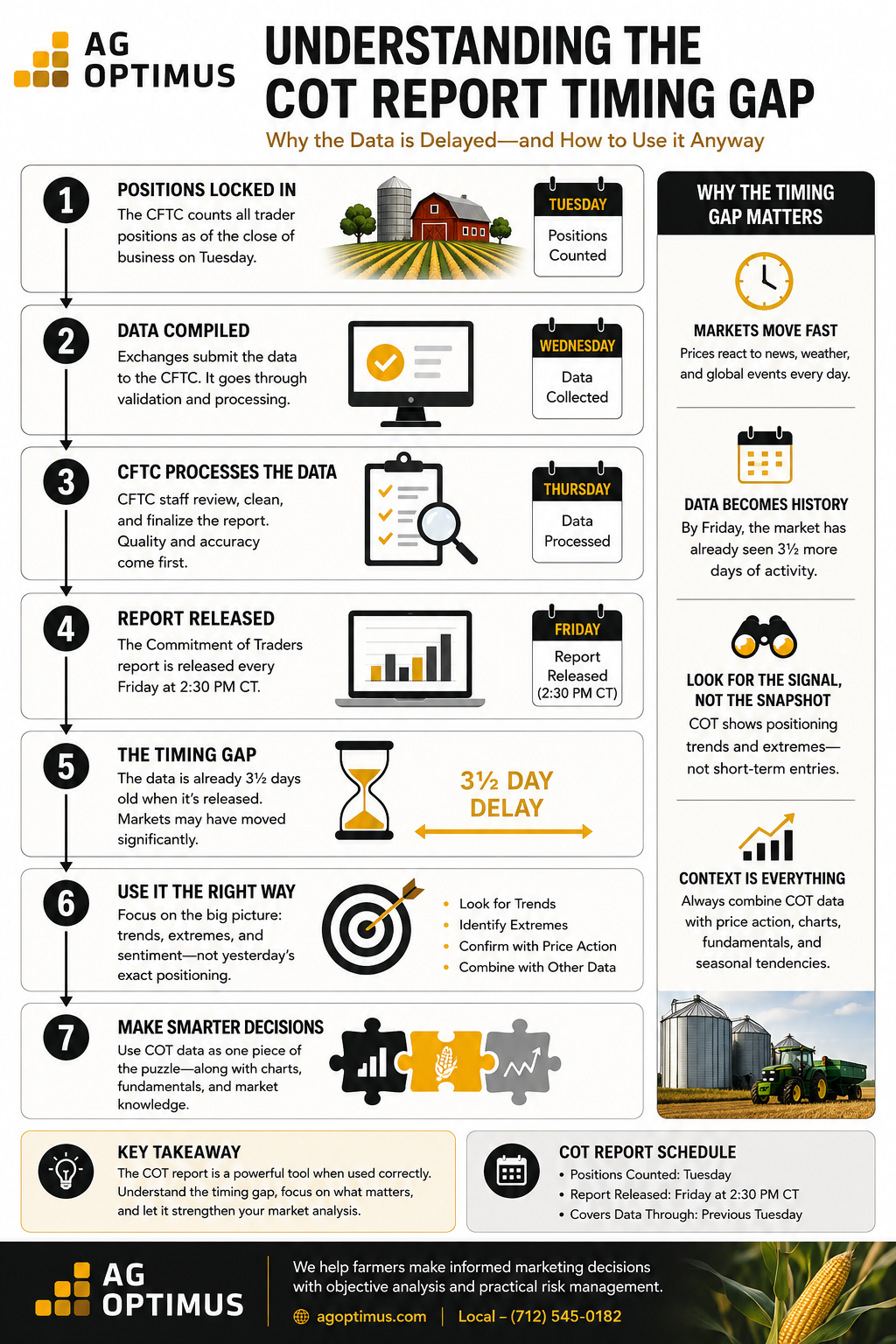
Here’s the calendar that trips everyone up. The CFTC freezes trader positions at Tuesday’s close. It compiles the data and releases the report on Friday afternoon, around 2:30 Central. If you read it the moment it drops Friday afternoon, the positions are already three days old. If you don’t get to it until Monday, once the week gets going, add a weekend on top. Either way, follow the chain: recorded Tuesday, published Friday. By the time those numbers reach your kitchen table, they describe the market as it stood at least three days earlier — and often the better part of a week.
That’s not a flaw you can fix by reading faster. Even the most on-top-of-it producer, reading it the instant it releases Friday, is looking at positions that are already three days old. The report is structurally a look in the rearview mirror. The whole skill of using it is knowing how far back that mirror sees — and never mistaking it for the windshield.
Why the COT Report Timing Gap Bites: A Week Can Change Everything
A three-day gap — longer if you read it on Monday — wouldn’t matter much if nothing happened in between. But something almost always happens in between — and in grain and livestock, the “something” is usually a USDA report.
Picture the grain side. The funds build a record net long in corn by Tuesday’s close — loaded up, betting on higher prices. Wednesday’s quiet. Then Thursday morning, USDA drops a WASDE that’s bearish: bigger carryout than the trade expected, supplies heavier than anyone wanted. The market sells off, and those funds start heading for the exits on Thursday. Friday afternoon, the COT comes out still showing “funds are record long corn” — because that’s where they were Tuesday, before the report dropped. You read it, think there’s still room to run, and hold your bushels. But that record long is already unwinding. You’re holding onto weakness based on a position that’s coming apart.
The livestock side has the exact same trap with a different calendar. Cattle on Feed lands on a Friday. Cold Storage, monthly. The funds’ cattle position recorded last Tuesday can be a week stale before a feeder ever reads it — and a single bearish on-feed number, or a packer bid that comes in softer than expected, can have managed money repositioning before the report you’re reading was even published. A feeder who sees “funds are long live cattle” and assumes there’s support under the market may be leaning on a position that’s already been cut.
The lesson is the same for both: the COT tells you where the crowd was, not where it is. When a major report lands inside the gap, “was” and “is” can be a long way apart.
What the COT Is Actually Good For — Conditions, Not Forecasts
None of this means the report is useless. It means you read it for the right thing. Think of it like the rearview mirror: it shows you the road you’ve already traveled — clearly, in detail, how crowded the trade got and how much fuel is in the tank for a move in either direction. What it can’t show you is the windshield. It tells you where the market has been, not what’s coming around the next bend this morning.
For both grain and livestock, that reframes the report from a trigger into a backdrop. A crowded long means most of the buyers are already in — so a bearish surprise has a lot of longs rushing for the same exit. A crowded short means most of the sellers are already in — so a bullish surprise can spark sharp short-covering. The COT doesn’t predict which surprise comes. It tells you which side of the market is more crowded — and therefore more exposed if the news cuts against it.
Managing Risk Around the Gap: For Grain Farmers
If you grow corn or soybeans, three habits keep the gap from costing you. First, when the funds are stacked at an extreme long, and a major USDA report is on the calendar, be cautious about waiting to price unpriced bushels. A crowded long is a crowded exit, and if that report comes in heavy, the unwind can take prices down faster than the fundamentals alone would justify. That’s the setup where “I’ll wait for another dime” quietly costs you a dollar.
Second, when the funds are at an extreme short heading into a weather market or a potentially bullish supply surprise, don’t panic-sell into the weakness. That extreme short is a tank of buying fuel — when the story turns even a little, the short-covering can run further than the fundamentals suggest. Dumping bushels right before that spark is how good grain gets sold at the low.
Third, treat the Friday release as a weekly context reset rather than a Monday trigger. Once a week, ask one question: Is the trade crowded, and which way? Then carry that as background. Your pricing call still comes down to your breakeven, your local basis, and your bin space — real bushels and real dollars, not a week-old headcount.
Managing Risk Around the Gap: For Cattle Feeders and Livestock Producers
The same logic translates straight to the feedlot, with the livestock calendar layered on top. First, watch how the COT lines up with the livestock report schedule. If managed money is at an extreme in live or feeder cattle and Cattle on Feed or a WASDE is due inside the gap window, the position you’re reading is the most likely to be stale by the time you act on it. Treat an extreme reading right before a report as a caution flag on your own exposure, not a green light.
Second, anchor on your own marketing window, not the funds’. A feeder’s pricing decision is driven by close-out dates, breakevens, and local basis — when the pen finishes and what the packer is actually bidding. The COT is national futures context sitting on top of that. If an extreme fund position happens to line up with a board price over your breakeven and a workable basis, those signals reinforce each other. When they conflict, your close-out math wins.
Third, remember that livestock markets can move on cash and packer behavior that futures positioning doesn’t fully reflect. Funds trade the board, while your cattle sell into a cash market shaped by showlists, kill schedules, and regional supply. Futures and cash move together over time, but a week-old positioning report can sit a step apart from what your local cash market is doing right now. Use it for the crowd read, then look out the window at your own basis and your own pens.
The Bottom Line on the COT Report Timing Gap
The COT report isn’t a live feed and was never meant to be. Recorded Tuesday, released Friday — already three days old the moment you can read it, and older still if you wait for Monday. Any USDA report that landed in between may have already changed the story. Read it for what it does well: a gauge of how crowded the trade has gotten and which side is more exposed if the news turns. Then make the actual decision on the things that don’t go stale — your breakeven, your basis, your bin space or your close-out window. Do that, whether you’re pricing beans or selling fats, and the gap stops being a trap and starts being just one more honest piece of context.
At Ag Optimus, our brokers farm and feed too. If you want help reading where positioning sits and fitting it next to your breakeven and your local basis — in plain language, no pressure — we’re here to visit.
Toll Free: (800) 944-3850 • Local: (712) 545-0182 • agoptimus.com
Frequently Asked Questions
How old is the COT data when I read it?
The positions are recorded at Tuesday’s close, and the CFTC releases the report Friday afternoon — so even if you read it the instant it drops Friday, the numbers are already three days old. If you don’t get to it until the following Monday, you’re looking at data closer to a week old. The three-day floor is baked into the report itself and can’t be read away.
Why does the Tuesday-to-Friday gap matter so much for grain and livestock?
Because major USDA reports often land inside that window. A WASDE, Cattle on Feed, or Cold Storage report released between Tuesday’s snapshot and Friday’s release can cause managed money to reposition before you ever see the “old” numbers. In grain and livestock especially, a week is plenty of time for the crowd to change its mind.
Should I price grain or sell cattle based on what the funds are doing?
Not as a direct trigger. The funds’ position is a week-old national futures context, not a signal timed to your operation. Use it to gauge whether the trade is crowded and which way. Your actual decision should rest on your breakeven, your local basis, and your bin space or close-out window — the things that reflect your real bushels and real cattle.
What does an extreme fund position tell a producer?
An extreme means the crowd has leaned unusually far one way compared to its own recent history. At an extreme long, most buying fuel is spent, so a bearish surprise can trigger a fast unwind. At an extreme short, a bullish surprise can spark sharp short-covering. It doesn’t predict the turn or its timing — it tells you which side of the market is more crowded, and therefore more exposed if a surprise hits.
Is the COT report less reliable for livestock than for grain?
It carries the same staleness for both, but livestock has an extra wrinkle: cattle sell into a cash market shaped by showlists, kill schedules, and regional supply that futures positioning doesn’t fully reflect. So a week-old COT can sit a step apart from a feeder’s cash reality. It’s still useful for the crowd read — just keep it one step behind your own basis and close-out math.