Formula vs. Negotiated Cattle Sales: Which Pricing Method Works Best for Feeders?
For cattle feeders, selling finished cattle is not simply a matter of deciding when to sell. How the cattle are priced can be just as important.
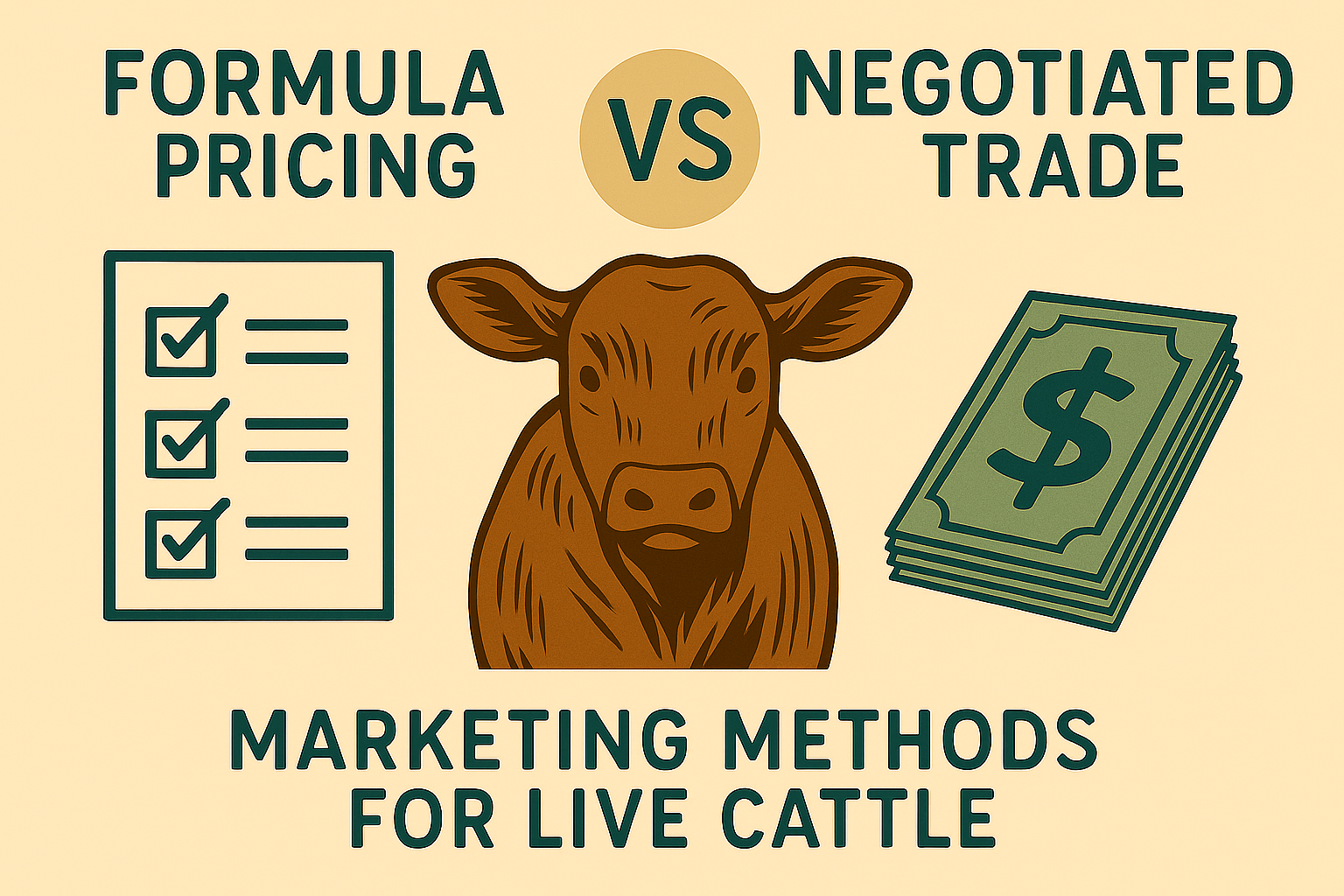
Two common methods are negotiated cash sales and formula pricing. With negotiated sales, the feeder and packer agree on a price for a specific transaction. With formula sales, the final price is generally determined using an agreed-upon pricing formula tied to a market reference or base price, with adjustments that may reflect cattle quality, yield, premiums, discounts, or other terms.
Neither method automatically produces a better result.
For a cattle feeder, the more useful question is:
Which pricing method gives my operation the right combination of price opportunity, predictability, flexibility, and risk management?
TL;DR
- Negotiated cattle sales allow feeders and packers to negotiate the price of cattle directly.
- Formula pricing uses a predetermined pricing method or market reference rather than negotiating the entire price for each transaction.
- Negotiated trade can provide more flexibility, but the price available depends on current local market conditions and bargaining dynamics.
- Formula arrangements can provide greater consistency and reduce the need to negotiate every group of cattle individually.
- Quality premiums and discounts can materially affect the final value of formula-priced cattle.
- Neither method guarantees a higher cattle price.
- Feeders should understand how their physical cattle will be priced before designing a futures or options hedge around them.
What Is a Negotiated Cattle Sale?
A negotiated cash sale is the traditional cattle transaction many feeders are familiar with.
The feeder and packer negotiate the price and terms for a specific group of cattle. Depending on the transaction, cattle may be priced on a live-weight or dressed-weight basis.
The important distinction is that the price is negotiated for that particular sale rather than determined automatically by a previously established formula.
For the feeder, this provides an opportunity to evaluate the market and decide whether the packer’s bid is acceptable.
But it also means the feeder is exposed to the cash market until a deal is made.
Simple example
Suppose a feeder has a pen of market-ready cattle.
A packer bids $225/cwt live.
The feeder believes the cattle are worth more and counters at $227.
They ultimately agree at $226.
That $226 negotiated price becomes the cash price for that transaction.
The actual process can be considerably more complicated, but the principle is straightforward:
Buyer and seller negotiate the price.
What Is Formula Pricing for Cattle?
Formula pricing works differently.
Instead of negotiating the entire cattle price each time cattle are sold, the feeder and packer establish a pricing arrangement tied to an agreed-upon reference.
The final value can then be affected by factors such as:
- Base price
- Quality grade
- Yield grade
- Carcass characteristics
- Premiums
- Discounts
- Other specifications contained in the agreement
This can make marketing more predictable operationally because the feeder doesn’t have to negotiate every pen in the same way as a traditional cash transaction.
But the details of the formula matter.
A feeder needs to understand what establishes the base price and exactly how premiums and discounts are calculated.
Formula vs. Negotiated Cattle Sales
| Consideration | Negotiated Sale | Formula Sale |
|---|---|---|
| How price is established | Feeder and packer negotiate | Predetermined formula/reference |
| Price negotiation | Each transaction | Primarily established through formula terms |
| Quality adjustments | Depends on agreement | Often an important part of final value |
| Marketing flexibility | Generally greater | Depends on agreement |
| Pricing consistency | Can vary with each negotiation | More structured |
| Exposure to cash market | Until cattle are sold | Depends on formula and pricing date |
| Best suited for | Feeders wanting direct negotiation | Feeders wanting a more systematic pricing process |
Important: These are general characteristics. Actual cattle purchase agreements vary by packer, region, cattle type, and contract terms.
Why Would a Feeder Choose Formula Pricing?
One of the biggest attractions is consistency.
A large feeder moving cattle regularly may not want every group of cattle to require a separate price negotiation.
Formula arrangements can create a more systematic marketing process.
They may also reward cattle that consistently meet desirable carcass specifications when premiums are part of the pricing structure.
But formula pricing introduces another consideration:
You need to understand the reference price.
If your cattle price is based on another market price, you need to know:
Where does that base price come from?
That question matters because the formula is only as meaningful as the price upon which it is based.
Why Would a Feeder Prefer Negotiated Trade?
Negotiated sales preserve the feeder’s ability to evaluate bids and negotiate directly with packers.
That can be valuable when cattle supplies, packer demand, regional availability, weights, weather, processing capacity, or other conditions change.
The tradeoff is uncertainty.
Until cattle are actually priced, the feeder doesn’t necessarily know what cash price will be available.
That becomes especially important when the operation has substantial money invested in feeder cattle, feed, yardage, financing, and other production costs.
Where Futures Hedging Fits In
This is where the distinction becomes particularly important for an Ag Optimus client.
How you sell the physical cattle and how you hedge the price risk are two separate decisions—but they need to work together.
A feeder might sell cattle through negotiated trade while using Live Cattle futures or options to manage price exposure before the cattle are sold.
A feeder using a formula arrangement may also use futures or options, but the hedge should account for how the formula establishes the eventual cash price.
The objective isn’t simply to put on a futures position.
The objective is to understand:
What physical cattle do I own, how will they eventually be priced, and what market exposure exists between today and that sale?
That is where an agricultural commodity broker who understands both the cattle business and the futures market can add value.
A Practical Feeder Example
Suppose a feeder expects to market cattle in October.
The operation already has substantial costs committed to the cattle and is concerned that Live Cattle prices could decline before the cattle are marketed.
Feeder A — Negotiated Cash
The feeder plans to negotiate directly with packers when the cattle are ready.
Until a cash sale is established, the feeder retains substantial exposure to cattle prices.
A futures or options hedge could potentially be used to manage part of that price risk.
Feeder B — Formula
Another feeder has cattle committed under a formula arrangement.
The cattle have a defined pricing mechanism, but their ultimate value still depends on the formula’s reference price and applicable premiums or discounts.
That feeder may also have price exposure worth managing.
Same cattle market. Different cash-pricing mechanisms. Different considerations when constructing the hedge.
Which Method Is Better?
There isn’t a universal answer.
For some operations, the flexibility of negotiated sales may be valuable.
For others, the consistency and operational efficiency of formula pricing may be more attractive.
The decision can depend on:
Operation size → cattle quality → packer relationships → regional market conditions → pricing transparency → marketing frequency → risk tolerance → hedging strategy
A feeder shouldn’t evaluate the cash-marketing decision in isolation.
The better question is:
How does the way I sell my cattle fit into my overall margin and risk-management plan?
What Cattle Feeders Should Ask Before Choosing
Before entering either arrangement, a feeder should understand:
- How will my base cattle price be determined?
- When will the cattle actually be priced?
- What premiums or discounts could apply?
- What happens if cattle don’t meet expected specifications?
- How much flexibility do I retain over marketing?
- What price exposure remains before the cattle are sold?
- How should my futures or options hedge correspond to that exposure?
Those questions matter more than simply asking whether formula or negotiated pricing is “better.”
How Ag Optimus Helps Cattle Feeders
At Ag Optimus, we work with cattle feeders who need to connect their physical cattle, expected marketing date, cash-pricing method, and futures-market exposure.
Our brokers understand cattle production as well as futures and options markets. That matters because a hedge should be built around the cattle you’re actually feeding and how you expect to market them—not around a generic futures-market strategy.
We help feeders evaluate Live Cattle and Feeder Cattle futures and options as part of a broader cattle price-risk management plan.
Frequently Asked Questions
Is formula pricing better than negotiated cattle sales?
Not necessarily. Formula pricing can provide a more structured pricing process, while negotiated sales allow the feeder and packer to establish the price directly. Which approach fits better depends on the operation, cattle, market conditions, and marketing objectives.
What is a formula cattle sale?
A formula sale uses an agreed pricing mechanism to determine the cattle’s value rather than negotiating the entire price for each individual transaction. The formula may incorporate a base market price along with premiums and discounts.
What is negotiated cash trade in cattle?
Negotiated cash trade occurs when a cattle seller and buyer directly negotiate the price and terms for a specific cattle transaction.
Can cattle feeders hedge formula-priced cattle?
Potentially, yes. Futures and options may be used to manage certain price exposures, but the feeder needs to understand exactly how the formula determines the cash price so the hedge corresponds appropriately with the underlying exposure.
Can cattle feeders hedge negotiated cattle sales?
Yes. A feeder expecting to negotiate cattle later may use Live Cattle futures or options to manage some of the price risk before the physical cattle are sold. Futures prices and local cash cattle prices do not necessarily move identically, so basis and other risks remain.
Does hedging determine how I have to sell my cattle?
No. The cash marketing method and futures hedge are separate transactions. However, they should be considered together because changes to the physical cattle sale can change the operation’s underlying price exposure.
Talk With a Cattle Hedging Broker Who Understands the Feedlot
Cattle marketing doesn’t stop with deciding formula or negotiated.
The bigger issue is understanding what price risk remains after that decision—and determining whether futures or options have a place in managing it.
Talk with an Ag Optimus cattle broker about your cattle, expected marketing window, pricing method, and hedge alternatives.
Toll Free: (800) 944-3850
Local: (712) 545-0182
Email: support@agoptimus.com
Futures and options trading involves substantial risk of loss and is not suitable for all investors. Past performance is not indicative of future results.