
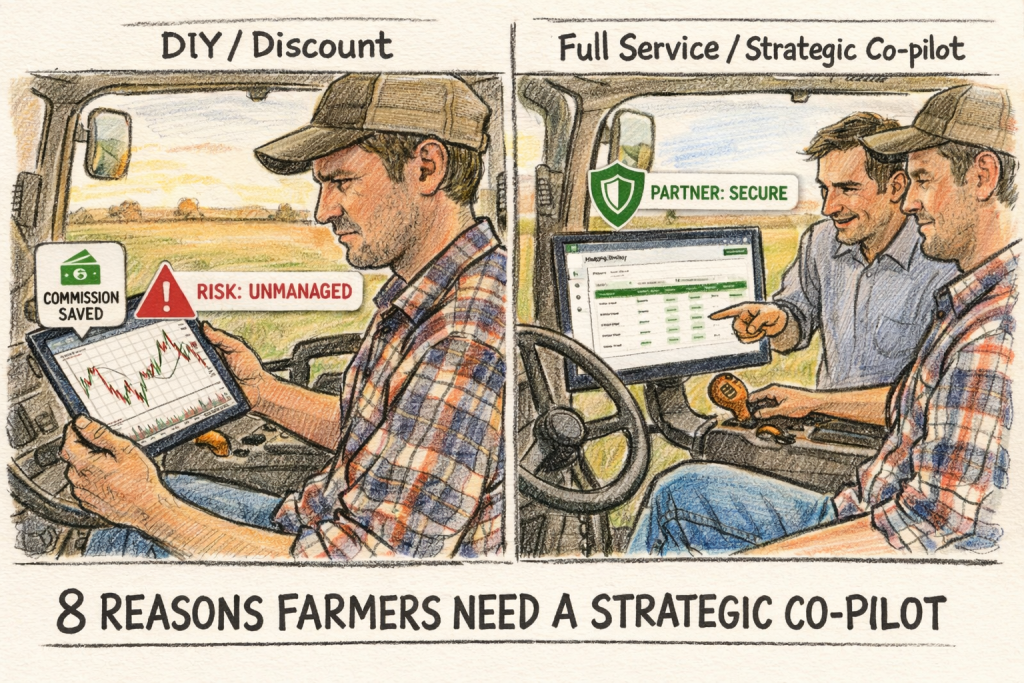
You Can Trade Your Own Account. The Question is: Discount vs full-service broker. What should you do?
TL;DR — The Short Version
-
The Trap: Trading your own account looks “cheaper” on paper.
-
The Reality: Farming is a full-time job. Trading while distracted in the field may lead to “fat finger” errors, missed market news, and emotional decisions that could cost significantly more than a broker’s fee.
-
The Solution: Ag Optimus acts as a second set of eyes, helping you monitor market movements that could impact your operation.
The Appeal of Going It Alone
There is a lot of pride in being independent. As a producer, you are already the agronomist, the mechanic, the vet, and the CEO. It makes sense that many of you look at brokerage commissions and think, “Why pay someone else when I can just place the order myself on my phone?”
We respect that. For some producers who have the time and the background, a discount account works fine.
But for most, the issue isn’t capability—it’s capacity. You are busy running a complex operation. Adding “Full-Time Risk Manager” to your job list can sometimes lead to costly, straightforward oversights.
Here are 8 common situations where having a partner on the other end of the line proves its worth.
1. The “Bumpy Road” Error
Trading apps are convenient, but they are unforgiving. We have seen seasoned producers try to exit a position while driving a tractor or pickup, only to accidentally hit “Sell” instead of “Buy” because they hit a bump.
Suddenly, instead of being flat, you are double-short. A competent broker confirms the trade details verbally, potentially reducing the risk of accidental errors common on small screens.
2. The Temptation to Speculate
Discipline is easy when the markets are quiet. It’s much harder when prices are moving fast. Without a broker to act as a disciplined sounding board, it is very easy for a “hedge” to drift into a “speculative play” because you have a hunch the market will bounce. A partner helps keep the account focused on its original job: protecting your cash flow.
3. Translating “Farm” to “Futures”
Your crop doesn’t grow in perfect 5,000-bushel increments. If you have 78,000 bushels to hedge, you have to do some math.
Do you round up? Round down? Use mini-contracts? If you miscalculate the conversion, you might end up over-hedged or under-protected. We handle that conversion math every day, ensuring your paper position matches your physical reality.
4. The Feedlot Puzzle
Cattle are even more complex. A futures contract is 40,000 or 50,000 lbs, but your pen of steers might be 62,000 lbs.
Trying to match those weights perfectly on your own is tricky. We help producers construct weighted averages or use flexible option strategies to cover those “odd-lot” differences so you aren’t leaving 12,000 lbs exposed.
5. Technology Has Limits in the Field
You might place a stop-loss order on your phone and head out to the field, assuming you are safe. But if the market gaps or liquidity dries up, that stop might not trigger where you think.
If you are out of service range, you won’t know until it’s too late. A broker monitors those working orders for you, calling you immediately if the market skips over your price.
6. You Can’t Be in Two Places at Once
When major USDA news breaks at 11:00 AM, you are likely working. By the time you get a chance to check your phone at lunch, the market may have already moved significantly.
A full-service broker is your eyes and ears. We watch the report release so you don’t have to, alerting you instantly if a change in strategy is needed.
7. Relationships vs. Algorithms
Discount brokers are automated. If your account dips below the margin requirement, their computer often auto-liquidates your positions immediately to protect the firm. They don’t ask questions, and they don’t call you first.
At AgOptimus, we believe in direct communication. If a margin call happens, our first step is to pick up the phone. We ensure you are aware of the situation immediately so it can be adequately addressed. We treat you like a professional partner who deserves a phone call, not just a silent liquidation by a computer code.
8. It’s Good to Have a Co-Pilot
Farming can be isolating. When you are making big financial decisions, doing it in a vacuum is tough.
Having a smart broker gives you someone to bounce ideas off of—someone who can say, “That’s a good idea, but have you considered how widening basis might affect that?” It’s about having a second set of eyes on your risk.
We Aren’t “City Brokers.” We Are Producers Too.
One reason many farmers hesitate to hire a broker is that they don’t want to explain farming to a guy in a suit who has never set foot in a feedlot.
AgOptimus is different.
We are not typical “City Brokers.” Our team consists of active ranchers, farmers, and cattle feeders.
-
We know what it feels like when it doesn’t rain.
-
We know the stress of calving season.
-
We understand that “selling” isn’t just clicking a button—it’s managing your livelihood.
You can do this on your own. But when the markets get volatile, and the farm gets busy, wouldn’t it be nice to know you have a smart partner watching the screen for you?
Frequently Asked Questions (FAQ)
Q: Does hiring a full-service broker mean I lose control of my trading?
A: Absolutely not. You are the boss; we are the co-pilot. We never place a trade without your authorization. You make the final call—we make sure you have all the information and strategy options before you decide.
Q: I only have a small operation. Am I “too small” for a broker?
A: Risk doesn’t care about size. Whether you are hedging 5,000 bushels or 500,000, a market drop hurts the same percentage of your bottom line. We work with operations of all sizes to scale contracts to fit your specific production.
Q: Why shouldn’t I use a discount app for the “easy” trades?
A: If you are caught in a losing position on a standard app, you are alone with the stress. You cannot ‘fix’ a losing trade, but you can manage the outcome. We provide the objective perspective to help you make the best decision for your operation — whether that means cutting the loss or adjusting the hedge.
Let’s Have a Conversation.
We aren’t here to push you; we are here to help you protect what you’ve built.
Call AgOptimus: (800) 944-3850
Email: support@agoptimus.com
Disclaimer: Trading futures and options involves substantial risk of loss and is not suitable for all investors. Past performance is not indicative of future results.