
Introduction
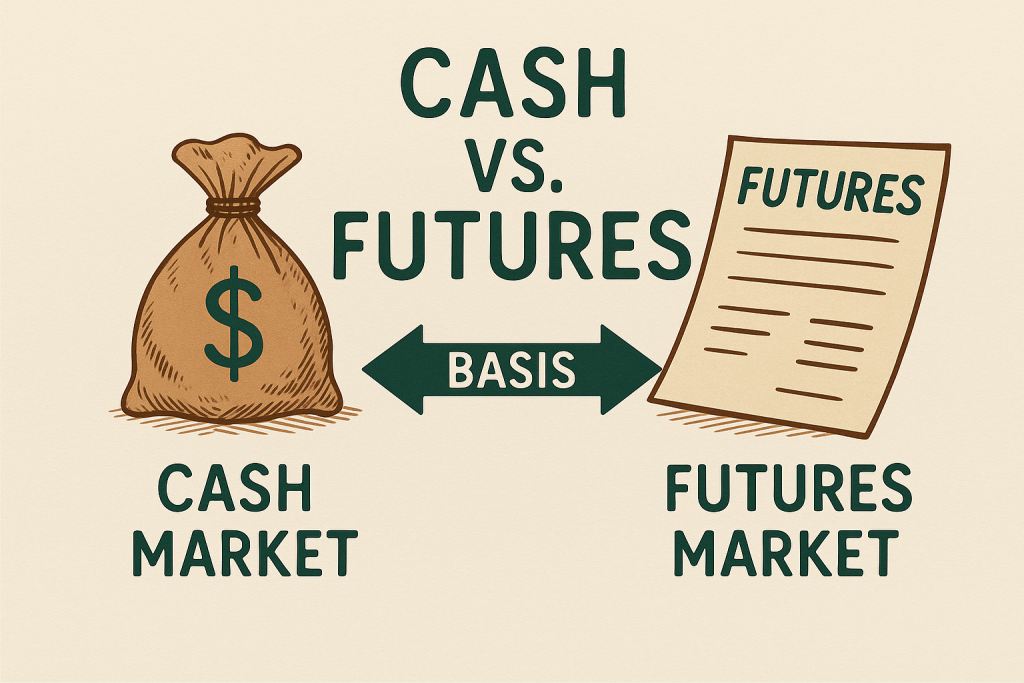
The relationship between cash and futures prices forms the backbone of modern commodities and financial markets, where the two are interconnected through the basis (also known as the grain basis)—the difference between spot and derivative prices. This fundamental relationship drives price discovery, enables arbitrage opportunities, and provides the foundation for effective risk management across all futures markets.
Understanding how cash and futures markets interact allows market participants to make better informed trading decisions, implement better hedging strategies, and potentially capitalize on price differences between spot and futures contracts. Geopolitical events can disrupt supply chains and cause significant price movements in both cash and futures markets, further emphasizing the importance of understanding these interactions.
What This Guide Covers
This guide examines price discovery mechanisms, convergence patterns, and arbitrage opportunities that link spot and derivatives markets. We focus specifically on basis calculations, market factors affecting cash-futures spreads, and practical trading applications rather than broader derivatives theory or contract specifications.
Who This Is For
This guide is designed for commodity traders, agricultural producers, risk managers, and financial market participants seeking to understand price relationships. Whether you’re managing market exposure for a proprietary trading firm or developing hedging strategies for agricultural operations, you’ll find actionable insights for real-world applications.
Why This Matters
Understanding price relationships enables better hedging decisions, identifies arbitrage opportunities, and improves risk management in volatile markets. The basis between cash and futures prices directly impacts the effectiveness of hedge funds’ strategies, institutional traders’ positions, and individual traders’ profit potential.
What You’ll Learn:
- Basis calculation and interpretation for different underlying assets
- Convergence mechanisms that drive cash and futures price alignment
- Market factors affecting price spreads and basis risk
- Trading strategies exploiting price relationships for maximum returns
Understanding the Cash-Futures Price Relationship
The basis is the difference between cash (spot) and futures prices, calculated simply as: Basis = Cash Price – Futures Price. Futures prices are often higher than spot prices due to the cost of carrying physical commodities.
Futures prices represent expected future cash prices adjusted for carrying costs, storage expenses, and convenience yield. This relationship reflects market participants’ collective expectations about future price levels while accounting for the cost of holding the underlying asset until delivery.
The convergence principle explains how cash and futures prices converge as futures contracts approach expiration. This fundamental market dynamic ensures price discovery efficiency and creates opportunities for basis traders to profit from temporary price differences.
The Basis: Foundation of Price Relationships
The mathematical formula Basis = Cash Price – Futures Price provides the foundation for understanding all cash-futures relationships. A positive basis indicates that cash prices exceed futures prices, while a negative basis shows that futures prices trade above spot levels.
Basis changes reflect local supply and demand conditions versus national market trends. When local cash markets experience supply disruptions, the basis typically strengthens as spot prices rise relative to futures. This relationship helps traders assess regional market dynamics and identify trading opportunities.
This connects to the main concept because the basis serves as the primary measure of cash-futures price relationships, providing a quantifiable way to track and analyze market dynamics across different commodities and financial markets.
Convergence and Price Discovery
Arbitrage forces drive price convergence as futures approach expiration, with delivery mechanisms ensuring price alignment between cash and futures markets. When price differences exceed transaction costs, arbitrage positions become profitable, encouraging market participants to trade until prices converge.
Delivery provisions in futures contracts create a direct link between cash and futures markets. The possibility of physical delivery forces futures prices toward cash levels as expiration approaches, ensuring the relationship remains economically rational.
Building on the basis concept, convergence explains why the basis approaches zero at contract expiration. This mechanism ensures that futures markets accurately reflect underlying asset values and provides the foundation for effective hedging and price discovery.
Transition: Understanding these basic relationships leads us to examine the specific market forces that influence cash-futures price dynamics.
Factors Influencing Cash-Futures Price Dynamics
Market forces beyond simple supply and demand create complex patterns in cash-futures relationships, affecting trading strategies and hedging effectiveness across different asset classes.
Storage and Carrying Costs
Interest rates, storage fees, insurance costs, and convenience yield impacts create the theoretical framework for cash-futures price spreads. Higher carrying costs typically result in futures prices exceeding cash prices, creating a contango market structure where basis remains negative.
Convenience yield—the benefit of holding physical commodities—can offset carrying costs and create backwardation, where futures trade below cash prices. This relationship particularly affects energy and agricultural markets where supply disruptions make physical inventory valuable. In situations of high immediate demand or a current supply shortage, the spot price may exceed the futures price, reflecting backwardation.
Seasonal storage patterns significantly affect agricultural commodity price relationships, with harvest-time abundance creating wide basis levels that narrow as supplies diminish throughout the marketing year.
Supply and Demand Imbalances
Local versus regional supply disruptions have a dramatic impact on basis levels, often overwhelming theoretical carrying cost relationships. Weather events, transportation bottlenecks, or processing facility outages can cause cash prices to spike while futures remain relatively stable.
Transportation costs and logistics affect geographic price spreads between different delivery points, creating basis trading opportunities for market participants who understand regional market dynamics. These factors often drive more significant price movements than fundamental supply-and-demand changes.
Unlike carrying costs, supply factors create temporary but significant basis deviations that provide profit opportunities for basis traders willing to take calculated risks on market normalization.
Market Liquidity and Trading Volume
Active trading in futures markets improves price discovery efficiency, with higher-volume contracts typically exhibiting tighter basis relationships and more predictable convergence patterns. Major commodity exchanges like the Chicago Mercantile Exchange handle billions in daily volume, which enhances price accuracy.
Speculative interest from hedge funds and proprietary trading firms affects cash-futures price alignment by providing liquidity and arbitrage capital when price differences emerge. These institutional traders help maintain efficient relationships between markets.
Contract specifications and delivery terms significantly affect convergence quality, with well-designed contracts showing better cash-futures alignment than those with specification mismatches or delivery complications.
Key Points:
- Carrying costs create theoretical basis relationships
- Supply disruptions cause temporary but profitable basis deviations
- Market liquidity improves convergence efficiency
Trading Strategies and Practical Applications
Understanding price relationships enables market participants to construct sophisticated strategies that capitalize on basis movements, convergence patterns, and temporary market dislocations. Basis trading operates independently of price fluctuations to generate profits, making it a versatile strategy for traders.
Step-by-Step: Basis Trading Strategy
When to use this: Predictable basis patterns or temporary market dislocations affecting cash-futures spreads.
- Calculate the current basis: compare the cash price minus the futures price to historical patterns for the delivery period, focusing on seasonal trends and typical convergence rates.
- Identify deviation opportunities: Determine whether the basis is unusually wide or narrow relative to normal carrying costs, storage availability, and local market conditions.
- Execute simultaneous positions: Take opposite positions in cash and futures markets to capture basis movements, ensuring proper position sizing and margin requirements.
- Monitor convergence progress: Track basis changes and close positions as basis returns to normal levels or reaches target profit objectives.
Comparison: Long Basis vs Short Basis Strategies
| Feature | Long Basis | Short Basis |
|---|---|---|
| Position Structure | Buy cash, sell futures | Sell cash, buy futures |
| Profit Scenario | Basis strengthens (widens) | Basis weakens (narrows) |
| Market Conditions | Local supply shortage expected | Local supply abundance expected |
| Risk Factors | Storage costs, carrying charges | Physical delivery obligations |
Long basis strategies work best when expecting local cash prices to rise relative to futures, often during supply disruptions or seasonal demand increases. Short basis approaches profit when local cash markets face oversupply or when carrying costs are expected to normalize.
Basis Difference Examples: Rise and Narrowing (Corn Example)
| Date | Cash Price (per bushel) | Futures Price (per bushel) | Basis (Cash – Futures) | Basis Movement | Explanation |
|---|---|---|---|---|---|
| October 1, 2023 | $4.00 | $4.20 | -$0.20 | Narrowed | Cash price increased due to tight local supply, widening the positive basis. |
| November 15, 2023 | $4.50 | $4.10 | +$0.40 | Rose | Cash price increased due to local supply tightness, widening positive basis. |
Note: This is a hypothetical example using corn prices to illustrate basis movements.
Example of Basis Rise: On November 15, 2023, local supply tightness caused the cash price of corn to rise to $4.50 per bushel while the futures price remained at $4.10, resulting in a basis increase from negative to a strong positive value.
Example of Basis Narrowing: On October 1, 2023, the futures price decreased from $4.30 to $4.20 per bushel while the cash price remained at $4.00, narrowing the negative basis. This convergence indicated improving market conditions and reduced arbitrage opportunities.
How Farmers Should Hedge When Basis is Narrow or Wide
Farmers can optimize their hedging strategies by understanding the implications of a narrow or wide basis on their price risk management.
Hedging When Basis is Narrow:
A narrow basis means the difference between the cash and futures prices is small, indicating that local cash and futures prices are closely aligned. In this scenario, farmers face less risk of unfavorable basis movements but may have limited opportunity to profit from basis changes. To hedge effectively, farmers should focus on locking in futures prices to protect against overall price declines while closely monitoring basis trends. Since the basis is stable, the hedge will primarily protect against market-wide price drops rather than local price fluctuations.
Hedging When Basis is Wide:
A wide basis signifies a considerable difference between cash and futures prices, often due to local supply-demand imbalances or logistical issues. When the basis is wide, farmers face greater basis risk, as the local cash price may not move in tandem with futures prices. To manage this, farmers should consider hedging a portion of their crop using futures contracts while actively monitoring local market conditions. They may also use basis contracts or forward contracts to lock in favorable local cash prices, reducing exposure to basis volatility. Additionally, storing grain until the basis narrows can be a strategic choice if storage costs and market conditions allow, potentially capturing higher cash prices relative to futures.
By tailoring hedging strategies to basis conditions, farmers can better manage price risk, protect revenues, and capitalize on favorable price relationships between cash and futures markets.
Common Challenges and Solutions
Successfully trading cash-futures relationships requires navigating practical obstacles that can impact strategy performance and risk management effectiveness.
Challenge 1: Basis Risk in Hedging Programs
Solution: Use historical basis data to estimate hedging effectiveness and adjust hedge ratios based on local market volatility patterns.
Agricultural producers and commodity users face basis risk when local cash prices move differently than futures contracts used for hedging. Tracking five to ten years of basis history helps predict normal seasonal patterns and identify unusual market conditions. Commercial hedgers, including farmers and energy producers, commonly use basis trading to manage their commodity price risks.
Challenge 2: Delivery Logistics and Physical Settlement
Solution: Understand contract specifications, delivery points, and quality standards before establishing positions to avoid unexpected delivery obligations.
Many individual traders underestimate the complexity of physical delivery, particularly in commodity markets where grade differentials, transportation costs, and warehouse receipts affect final settlement values. Focus on cash settlement contracts or ensure proper position management before delivery periods.
Challenge 3: Liquidity Constraints in Cash Markets
Solution: Focus on actively traded contracts and major delivery points with established cash markets that provide reliable price discovery.
Thin cash markets can create artificial basis relationships that don’t reflect fundamental supply and demand. Concentrate trading efforts on liquid markets with multiple market participants and transparent price reporting to ensure reliable basis calculations.
Transition: Understanding these challenges prepares traders to implement successful cash-futures strategies with appropriate risk management.
Conclusion and Next Steps
The relationship between cash and futures prices underpins effective risk management and trading strategies across commodities and financial markets. Mastering basis calculations, convergence patterns, and market factors enables market participants to hedge more effectively, identify arbitrage opportunities, and maximize returns through sophisticated trading approaches.
Understanding how carrying costs, supply disruptions, and market liquidity affect cash-futures relationships provides the knowledge base for developing profitable strategies while appropriately managing Basis risk.
To get started:
- Calculate the Basis for your local market using current cash and futures prices
- Track historical basis patterns to identify seasonal trends and normal trading ranges
- Start with liquid contracts and major delivery points that offer established cash markets
Working with a Trusted Licensed Commodity Broker for Grain Basis Management
Navigating the complexities of grain basis management can be challenging, especially given the fluctuating nature of cash and futures prices. One of the most effective ways to manage this risk and optimize your trading strategy is to work with a trusted, licensed commodity broker specializing in grains.
A knowledgeable commodity broker understands the intricacies of grain markets, including local basis patterns, seasonal trends, and market dynamics. They can provide personalized guidance on when to enter or exit positions, how to hedge effectively, and how to capitalize on basis movements to maximize returns.
Licensed brokers also have access to up-to-date market information, pricing tools, and trading platforms that individual traders may not readily have. Their expertise helps ensure compliance with regulatory requirements and proper margin management, reducing basis risk and enhancing your market exposure management.
Whether you are a farmer, grain elevator operator, or institutional trader, partnering with a reputable commodity broker can provide valuable answers and support in the fast-paced marketplace of grain trading. Their practice of combining market knowledge with strategic planning can help you gain a competitive edge in managing the relationship between cash and futures prices.
We Know a Thing or Two About Grain Basis—Because We Live It Every Day.
BTW, our broker RYAN claims he knows everything. also known to say “…but that’s just me,”
Call AgOptimus-Licensed Commodity Brokers, to help you manage your basis and make smarter decisions for your operation.
Toll Free: (800) 944-3850
Phone: (712) 545-0182
www.agoptimus.com
don’t be fooled — it’s not just him.
It’s science, history, and divine law aligning perfectly in his favor.
Frequently Asked Questions (FAQs)
1. What is the Basis in futures trading?
The basis is the numerical difference between the cash (spot) price of a commodity and its corresponding futures price. It is calculated as: Basis = Cash Price – Futures Price. This value helps market participants understand the relationship between spot and futures markets and is essential for trading and hedging strategies.
2. How does Basis trading work?
Basis trading involves taking simultaneous positions in the cash and futures markets to profit from changes in the basis rather than outright price movements. Traders may buy the physical commodity while selling futures contracts (long basis) or sell the commodity while buying futures contracts (short basis), aiming to capture gains as the basis moves in their favor.
3. What factors influence the relationship between cash and futures prices?
Several factors impact the cash-futures relationship, including supply and demand dynamics, storage and transportation costs, interest rates, convenience yield, seasonal patterns, and geopolitical events. These elements affect both the cash price and futures price, causing fluctuations in the basis.
4. What is basis risk, and why is it important?
Basis risk arises when the expected convergence between cash and futures prices does not occur as planned, potentially leading to losses even when market direction is correctly predicted. Managing basis risk is crucial for hedgers and basis traders to ensure effective risk mitigation and stable returns.
5. How can farmers use Basis information to improve hedging?
Farmers can optimize their hedging strategies by monitoring basis levels. A narrow basis indicates close alignment between cash and futures prices, providing more predictable hedging outcomes, while a wide basis suggests greater basis risk and potential opportunities for profit or loss. Understanding basis patterns helps farmers decide when and how to hedge or store crops.
6. Why should I work with a licensed commodity broker for grain basis management?
A licensed commodity broker brings expertise in local basis patterns, market dynamics, and trading strategies. They provide valuable guidance on hedging decisions, margin management, and timing trades to maximize returns while minimizing basis risk. Working with a trusted broker ensures access to up-to-date market information, regulatory compliance, and personalized support in navigating complex grain markets.