
Overnight prices were firmer on the technical reversal from yesterday and lower than expected crop progress ratings. Chartists and technicians see the reversal in bean trade as constructive, and Monday night features follow-through. Beans gained on corn, meal gained on soyoil, and corn gained on wheat. Weather remains hot and mostly dry, and overall is bullish.
On the demand side, after the close Egypt tendered for wheat with the last tender on July 14, where Romanian origin was purchased. So far Ukraine has the lowest offer. In weekly grain inspections for corn yesterday, for the week ending July 22 only 1.037 mmt was shipped, which was behind 1.077 mmt wk ago, but better than yr ago 0.841 mmt. Corn still lags USDA projections. Bean inspections were better with shipments marketing year-to-date totaling 2.133 bln bu, falling just short of USDA projections at 2.270 bln bu.
WEATHER – Heat and humidity is going to build throughout the Midwest, sending temperatures close to 100 degrees by Thursday, some areas even higher. Drier than normal conditions are going to be in place over the next few days, with the western cornbelt remaining dry. Temperatures are expected to decline by the weekend. 6/10 day outlook: scattered showers will cross over the weekend, with temperatures near normal by Saturday, near to below normal Sunday through next Wed.
REPORTS
Crop progress
beans: 58% good/excellent, down 2%, and vs. 72% yr ago. The poor to very poor category increased to 12% from 11% yr ago. Michigan and Mo. saw the best improvement, while Iowa, Kansas, Minn., and North Dakota saw declining conditions from 5-6%. Blooming: 76% vs. 63% wk ago. Setting pods: 42% vs. 23% wk ago.
corn: 64% good/excellent, down 1%. Poor/very poor was 10%, up 1% WOW. Improvements were in Mo. and Michigan. Illinois, Iowa, Minn., and Kansas saw the greatest deterioration. Dough stage: 18% vs. 20% yr ago, and 17% average. Silking: 79% vs. 73% average.
winter wheat: 84% harvested vs. 80% yr ago, and 81% average.
Spring wheat: 9% good/excellent, down 2%, with poor to very poor 3% higher to 66%. Montana was down 8%, Minn. was down 6%, with only Idaho improving by 5%.
ANNOUNCEMENTS
Argentina’s Rosario Exchange stated that bean crush reached a total of 22.06 mln mt for the first half of 2021, marking the highest volume since 2016. For the first half of 2020, crushing was around 19.07 mln mt, while volume for the second half totaled nearly 17 mln mt.
EU’s MARS crop monitoring unit made limited changes to crops saying that exceptionally high rainfall in several countries was likely to hit grain quality rather than yields.
JBS has imported 30 ship loads of corn into Brazil from Argentina due to their supply deficit, (drought and frost), according to Reuters. JBS noted purchases from suppliers outside Brazil already represent 25% of the corn it is using as feed, with volumes surpassing 1 mln tonnes. Brazil’s export pace for corn is the slowest in six years, due to their decimated Safrinha crop. According to Refinitiv trade flows, Brazil shipped only 89 thousand tons of corn in June, with 1.5 mln delivered in July, vs. 3.1 mln tns yr ago.
Russia’s southern region of Krasnodar, one of the country’s largest producing wheat and export aeras, harvested a record grain crop of 12.4 mln tonnes, as reported by its gov. on social media.
Argentina’s Rosario Exchange sees 21/22 soy planting falling by 1.5%, the lowest in 15 years, as farmers swap out beans for other crops, particularly corn.
Calls are as follows:
beans: 15- 17 higher
meal: 4.00-4.50 higher
soyoil: 15-20 higher
corn: 5 1/2 to 6 1/2 higher
wheat: 2 1/2-3 1/2 higher
Outside markets feature a lower stock market down 100 pts in front of a Fed meeting, and a weaker US dollar which trades down to 92.55. Crude oil trades up to $72.33/barrel.
Tech talk: November bean prices traded down to key support where the 100 day MA and trendline support crossed at $13.35, but ultimately stayed in the current price pattern which features a large sideways chop up to $14.15. The turn higher from lower is supportive, and implies that the market is now capable of trending up towards recent peaks at $13.95/$14.00 for today. Look for pullbacks today to see support, as ratings declined and current conditions are hot and dry. December meal had two sharp down days to trade under key support at $355.00, but ultimately could not stay under $350.00 with a nice rally back today. The chart ultimately rejected the trade under $350.00 as too low, and would therefore look for prices to continue to climb back towards the middle of its $355.00 to $385.00 trading range again. This still makes the $355.00 to $360.00 attractive if needing to price or cover a short. December soyoil chart remains friendly with good upside follow-through on breaks, and a trading range from 60c to 66c. The pullback last week to 6058c was right to trendline support which held for another recovery bounce. Prices will hit light resistance at 6480c, but think this chart construction is designed to move over 65c again as the major direction is sideways to higher.
December corn is more steady now as prices briefly took out its 100 day moving average at 5.35 triggering sell-stops, with no downside follow-through and a turn higher today. Prices are slowly climbing back into the previous uptrend channel it broke. The price action verifies that $5.35 – $5.75 is the range for this market now, and with funds long we could see support reinstated to $5.45 with a slight trend higher for the balance of the week.
December wheat trading range is from $6.75 to $7.25, but double highs at $6.93 may be a selling point if it lasts into the end of the day. The 100 day moving average crosses today at $6.73, and this is one market that may go there should we cross into the red. Funds are slightly short, and therefore would prefer to sell a rally here. In the big picture the market here still has the potential to stay rangebound from $6.70 – $7.25.
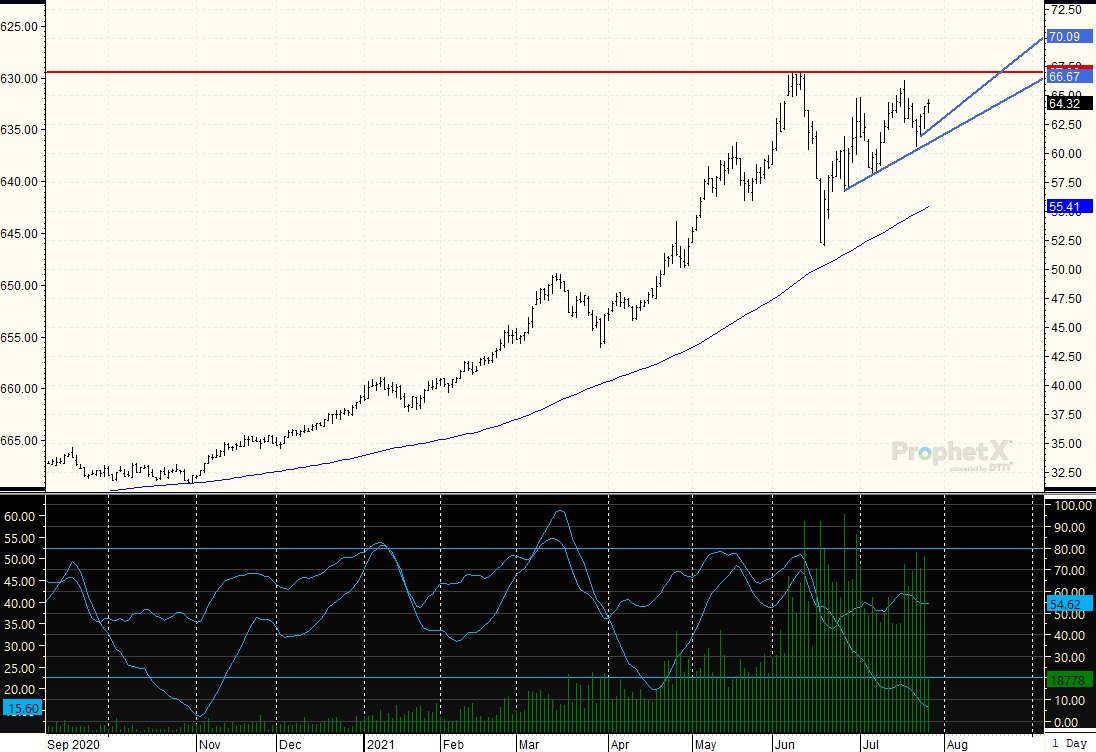
DECEMBER SOYOIL: This market remains extremely constructive as the major trend is sideways to higher enabling traders to purchase breaks of size followed by good rallies. Last week’s pullback to 6058c met trendline support and did not break it, with a solid recovery higher since. This implies that strength will continue to hold, even the major ADX reading is weak at 16, (anything under 25 shows weak trend). Major tops cross at 6770c, but rising price action suggests that in time we could get there. Look to target 65c – 6550c in the short term, higher in the long run. It remains that higher soyoil prices have been constructive for beans, and would expect this pattern to also remain intact for now.
Receive Relevant and Timely Grain Market Reports that Matter!
Get updated twice a week with concise, direct information that you can use in grain trading, marketing, and farm management
Better yet, become a customer and get DAILY updates, fundamental, and technical, sent straight to your Inbox! Contact Us now to get started.
RISK DISCLAIMER: Trading in commodity interest products such as futures, options and otc swaps entails significant risks of loss which must be understood prior to trading and may not be appropriate for all investors. You should carefully consider whether trading is suitable for you in light of your circumstances, knowledge, and financial resources. You may lose all or more of your initial investment. Opinions, market data, and recommendations are subject to change at any time. The placement of contingent orders by you or broker, or trading advisor, such as a stop-lossor stop-limitorder, will not necessarily limit your losses to the intended amounts, since market conditions may make it impossible to execute such orders. Long options strategies could lose their entire premium plus transactional costs. Short options strategies entail unlimited risk of loss plus transactional costs. The information presented represents the opinion of Ag Optimus. Past performance of actual trades or strategies cited herein is not necessarily indicative of future performance. Futures prices factor in the seasonal aspects of supply and demand. This communication may cite historic data and should not be taken to mean certain trades can produce dramatic profits year in and year out. This information does not imply customers have or will experience profits based on seasonal trades or trade data. All information, communications, publications, and reports, including this specific material, used and distributed by Optimus Futures, LLC (“Optimus”) shall be construed as, or is in the nature of, a solicitation for entering into a derivatives transaction. Optimus does not distribute research reports, employ research analysts, or maintain a research department as defined in CFTC Regulation 1.71. This email may include information produced by third parties. Material not labelled Optimus Futures should be considered to be third-party, and is provided for informational purposes only. Third-party material is from sources believed to be reliable, but its accuracy is not guaranteed by Optimus Futures. Optimus Ag and Ag Optimus are registered dbas of Optimus Futures LLC [NFA ID 0481133] CONFIDENTIALITY NOTICE: Privileged/Confidential information may be contained in this message. If you are not the intended recipient, please notify the sender immediately and you must not use the message for any purpose nor disclose it to anyone. Communications on all mediums may be recorded.