
Prices started the PM session on a mixed note with weaker grains vs. higher soy. Oilshare turns lower today on weaker energies.
Wheat prices are fed by the bull, with rising Black Sea prices and too much rain in Australia as harvest continues. Early harvest results for the near record crop are showing lower-than-expected protein levels, raising concerns over supplies to a market already suffering a shortfalls. Covid restrictions could bring more demand for domestic supply as possible lock-downs continue. An article talking about renewed tensions between Russia and Ukraine is also price positive, same as it was six years ago when Russian troops invaded the Crimea. Friction between Russia and Ukraine in the past has created significant short-covering rallies in wheat. Wheat prices continue to stay close to contract highs, with sellers not willing to step in.
Corn continues to be a follower of stronger wheat markets. Midday export inspections yesterday were low end, with China taking 210k Metric tons out of the Gulf. Year-to-date shipments are now 7.608 ml mmt which lags 9.299 mmt yr ago. Ethanol remains a major bid, as margins remain good. Corn basis levels are slowly working higher, with Neb. corn bids at the highest level in nine years nearby.
Bean weekly export inspections also fell, down 29% from the prev. wk. Fund buying remains the key to bean direction, while positive crush margins provide the bid in the market. Product trade continues to be about strong oilshare, but meal values remain well bid on good demand and possible substitutions in feed.
WEATHER – 6-10 and 8-14 day outlook for the US shows a drier trend which should take harvest to completion. SA weather appears to offer up a bit of a drying trend which traders will monitor closely in lieu of advertised La Nina developments. So far there is not much of a reason to pencil in weather premium with the fast start and good rains this past month.
REPORTS
Crop progress
corn: 95% harvested – Three states were less than 90% harvested, namely Ohio, MIchicgan, and Pennsylvania.
beans: 95% harvested
winter wheat: 44% good/excellent vs. 46% wk ago. 96% planted, less than market expectating and 94% wk ago. HRW states Kansas conditions down 3% and Texas down 2%.
ANNOUNCEMENTS
Brazil’s bean planting at 86% according to AgRural, advancing 8% on the wk and ahead of yr ago. Summer corn planting is 91% as of Nov. 18.
Ukraine Ag Ministry raised its corn production to 40 mmt, up 2.9 mmt vs. wk ago.
A steady rise in Chinese pork imports combined with rising fodder, fertilizer, and energy costs will support a recovery in pork prices over the year, the head of Europe’s biggest pork producer said on Tuesday. EU pig prices are currently down over 17% vs. yr ago.
Calls are as follows:
beans: 5-8 lower
meal; 1.20-1.60 lower
soyoil: 60-70 pts lower
corn: 2 1/2-3 1/2 lower
wheat: 1/2-1 lower
Outside markets are fairly quiet with the outstanding feature of lower crude which trades down to $75.30/barrel. The US dollar trades to 96.30 while stocks are up 20 pts.
Tech talk
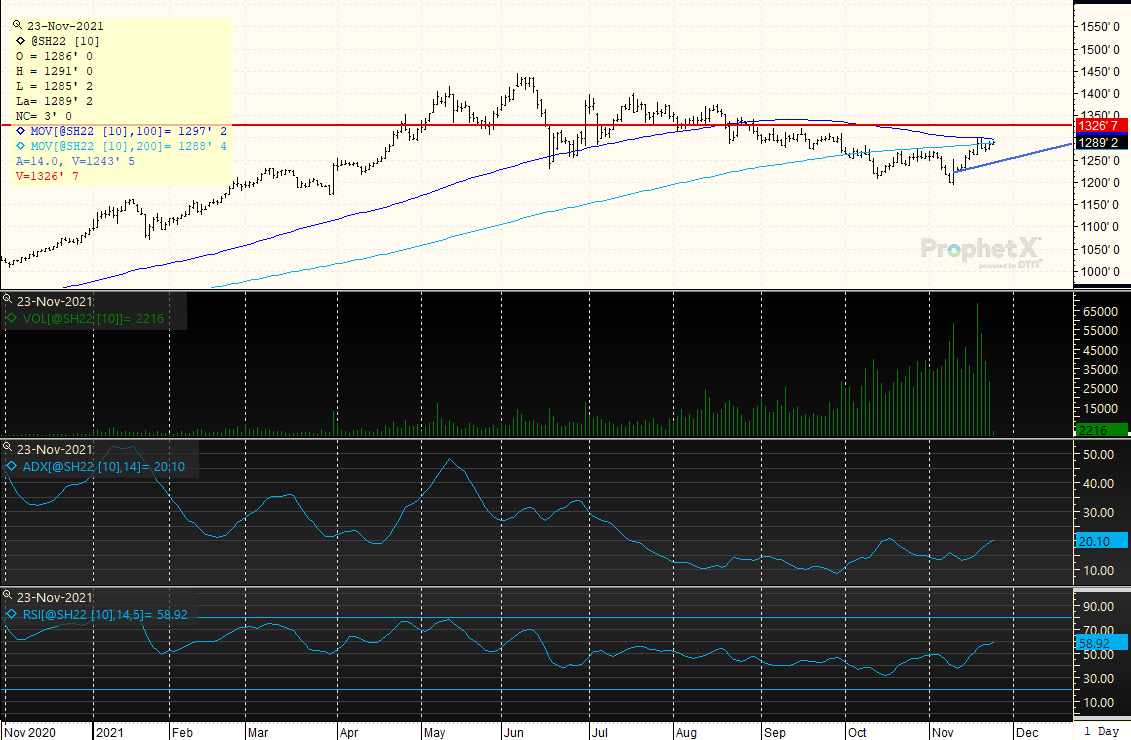
Soy: Jan beans retreat this AM from key resistance levels represented by converging 100/200 day moving averages at $12.95. Major direction is sideways, and while the market is operating in the upper portion of its trading range it has yet to hop over major resistance. Volumes have been turning lower, and energy is needed for markets that intend to move through stiff resistance levels like this. ADX is trendless at 19, but pullbacks are still likely to invite short-covering in lieu of the rally. Look for a sideways 12.50-12.95 trade until a weather problem or significant buying from China occurs. Jan meal chart is also showing a downside vulnerability, not able to rally yesterday and turning into the lower support line to begin the day. WOuld look for the possibility that a return to key support means a likely move through it so that a new and higher trading range may be established. Look for the 100 day to provide major support on a deeper pullback which crosses at $346.00. Think we may begin to go there. Jan soyoil futures remain back and forth from 5750c-60c. Chart is clear that any break of double lows at 5750c sets off a corrective pullback to 55c. If wanting to be long, have to have those stops close under 5750c in order to avoid the deeper downfall. Trading range for now is 5750c – 63c.
Grains: March wheat charts are still very constructive, and staying very close to recent ctr highs. Visual trendline resistance is close to what would be a new contract highs of $8.65 should we go there. The behavior of this bull market suggests that we still can set new contract highs before the holiday, as the market has all the characteristics of a bull, namely rising volume, rising open interest, and new ctr high. ADX is strong at 35, meaning pullbacks are places to own. Trading range for now is from a new and higher $8.10-$8.55, with possible new highs of $8.65 on the horizon. Charts are slightly overbot, but not severely. March corn is a follower of stronger wheat, but this is clearly a sideways direction which is likely to frustrate bulls and bears alike. Trend is non-existent, but given the friendly fundamentals and fund length have to own breaks of size. Prices remain trapped from $5.75 – $5.90, but targets above that are from $5.95-$6.05. For now a series of peak highs at $5.89 is capping off a larger rally, and the market may need a good fundamental to achieve an upside break-out. Until then, could straddle/strangle this range.
MARCH BEANS: Major direction is steady-higher as prices now trend into testing the 100 and 200 day moving averages which cross at $12.98 and $13.00. Typically when markets trend into moving averages they can rise above them. However for today the lower volumes are finding prices easing back towards the lower end of activity. Trade above $13.00 likely targets $13.25 based on past price patterns, the fact that beans like to tack on 20c -25c once they breach a benchmark, and the fact it was a previous peak high. Failure to take out these important moving averages will find prices drifting back down to $12.55/$12.60 for a continued $12.55-12.95 trading range.
Receive Relevant and Timely Grain Market Reports that Matter!
Get updated twice a week with concise, direct information that you can use in grain trading, marketing, and farm management
Better yet, become a customer and get DAILY updates, fundamental, and technical, sent straight to your Inbox! Contact Us now to get started.
RISK DISCLAIMER: Trading in commodity interest products such as futures, options and otc swaps entails significant risks of loss which must be understood prior to trading and may not be appropriate for all investors. You should carefully consider whether trading is suitable for you in light of your circumstances, knowledge, and financial resources. You may lose all or more of your initial investment. Opinions, market data, and recommendations are subject to change at any time. The placement of contingent orders by you or broker, or trading advisor, such as a stop-lossor stop-limitorder, will not necessarily limit your losses to the intended amounts, since market conditions may make it impossible to execute such orders. Long options strategies could lose their entire premium plus transactional costs. Short options strategies entail unlimited risk of loss plus transactional costs. The information presented represents the opinion of Ag Optimus. Past performance of actual trades or strategies cited herein is not necessarily indicative of future performance. Futures prices factor in the seasonal aspects of supply and demand. This communication may cite historic data and should not be taken to mean certain trades can produce dramatic profits year in and year out. This information does not imply customers have or will experience profits based on seasonal trades or trade data. All information, communications, publications, and reports, including this specific material, used and distributed by Optimus Futures, LLC (“Optimus”) shall be construed as, or is in the nature of, a solicitation for entering into a derivatives transaction. Optimus does not distribute research reports, employ research analysts, or maintain a research department as defined in CFTC Regulation 1.71. This email may include information produced by third parties. Material not labelled Optimus Futures should be considered to be third-party, and is provided for informational purposes only. Third-party material is from sources believed to be reliable, but its accuracy is not guaranteed by Optimus Futures. Optimus Ag and Ag Optimus are registered dbas of Optimus Futures LLC [NFA ID 0481133] CONFIDENTIALITY NOTICE: Privileged/Confidential information may be contained in this message. If you are not the intended recipient, please notify the sender immediately and you must not use the message for any purpose nor disclose it to anyone. Communications on all mediums may be recorded.