
TL;DR
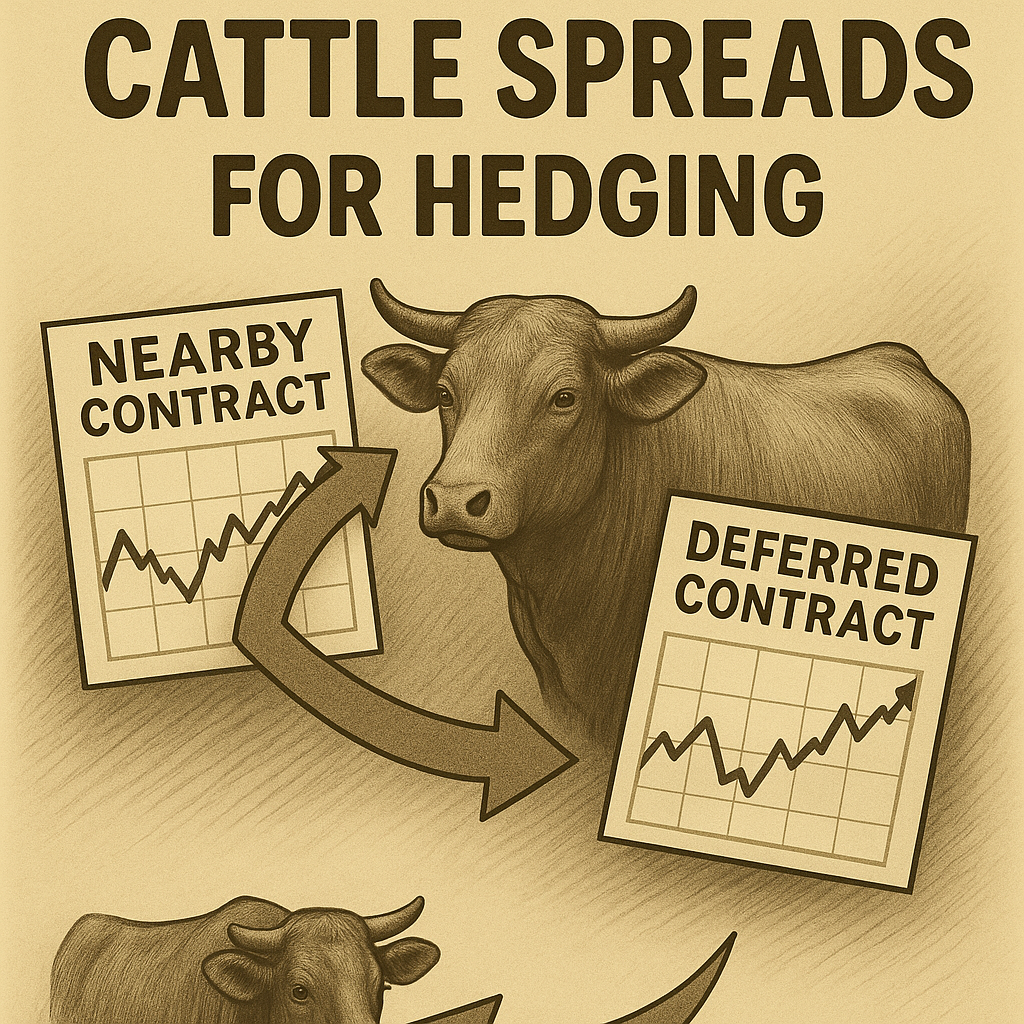
- A cattle spread is the price difference between two futures months; some feeders trade this difference, not the outright price.
- Spreads move because of real cattle fundamentals — carcass weights, placements, seasonal flows, packer demand, weather, and feed costs.
- Many feeders trade spreads accidentally when they hedge the wrong month and later roll.
- Spreads help manage timing risk, reduce margin cost, and smooth transitions between contract months.
- They do not lock in a final cattle price — they hedge month-to-month risk, not cash price.
- During extreme volatility, spreads can reveal a synthetic true price even when outright futures are locked limit-up or limit-down.
- Spreads can be used with puts, calls, and futures to build a more flexible hedging plan.
- Spreads help when: finish dates shift, the basis is uncertain, and the market is choppy.
- Spreads hurt when: cattle health delays finish, unexpected weather shifts seasonals, or the feeder hedges the wrong contract month.
- Successful spread hedging depends on matching the right month to the actual finish window and understanding seasonal behavior.
Intro Futures Cattle Spreads
Cattle spreads are one of the most useful—but often misunderstood—tools available to cattle feeders looking to manage price risk. While most feeders are familiar with hedging using outright futures or buying puts, fewer understand how the price relationship between contract months can protect margins, signal supply trends, and reduce timing risk.
This guide explains how cattle spreads work, why they move, and how feeders can use them to support a disciplined hedging strategy.
What a Futures Cattle Spread Actually Is
A cattle spread simply measures the price difference between two futures contract months. For example:
- Buy April / Sell June
- Sell February / Buy April
You are not trading the outright cattle price—you are trading the difference between months.
This spread reflects expectations about:
- Seasonal shifts in cattle supply
- Carcass weights
- Packer demand
- Weather impacts
- Feeding margins
- Forward placement levels
Because these factors change month to month, spreads help feeders understand where the market expects pressure or strength to first show up.
Why Futures Cattle Spreads Move
Spreads are driven by practical, real-world cattle fundamentals. The most common influences include:
Seasonal Flows
Different contract months represent different seasonal pressures. Winter storms, summer heat, fall placements, and spring grass all influence month relationships.
Carcass Weights
Heavier cattle often depress deferred contracts relative to nearby months.
Feed Costs
High-cost feeding periods change finish timing and often shift pressure into later contract months.
Packer Margins
The packers bidding aggressively for near-term cattle can strengthen the nearby month relative to deferreds.
On-Feed Numbers and Placements
Large upcoming supplies generally weaken deferred contracts and widen spreads.
Why Many Feeders Are Already Trading Spreads—Without Realizing It
This is extremely common:
A feeder has cattle finishing in February, but December futures are priced higher, so they hedge December and plan to “roll it later.”
That decision creates an automatic Dec–Feb spread position, even if unintentional.
If December strengthens relative to February before the roll, the hedge cost changes—sometimes significantly.
Understanding spreads helps feeders avoid surprises when they roll hedges from one month to another.
How Spreads Can Help Hedge Risk
Spreads aren’t designed to lock in a final sale price, but they provide several critical benefits:
Protect Against Timing Risk
If cattle finish early or late, spreads help adjust exposure between contract months.
Help Manage Basis Uncertainty
When local cash markets don’t align smoothly with a specific futures month (cash vs. Futures), spreads can rebalance exposure.
Learn more about Cattle Basis here: https://agoptimus.com/cattle-basis-explained-to-cattle-feeders/
Provide Lower-Risk Alternatives to Outright Futures
Month-to-month price differences often move less dramatically than outright cattle markets.
Reveal Market Structure
Strong or weak spreads often show where the market expects tightness or oversupply.
Lower Cost Entry
Spread margins are typically lower than outright futures positions.
How to Value a Limit Market Synthetically Using Spreads
When the cattle futures market is limit-up or limit-down, outright futures provide no usable hedge price — but the spreads often continue trading. Feeders can use this spread movement to estimate where the locked month should be trading. For example, if February cattle are limit-down and the Feb–Apr spread tightens from 2.00 to 0.80, the market is effectively pricing February even lower than the posted limit. This gives feeders a synthetic price discovery tool during extreme volatility, offering insights into true market pressure when outright futures are frozen.
How to Trade Futures Cattle Spreads
1. Identify Your Actual Finish Month
Don’t hedge the month that looks “best.” Hedge the month that matches your finish window.
2. Compare Nearby vs. Deferred Contracts
Look at how wide or narrow the spread is compared to normal seasonal behavior. For example, if Feb–Apr has been trading 1.50 to 3.00 over the past three years but is currently at 0.80, that’s unusually tight and worth noting.
3. Decide Whether the Spread Looks Too Wide or Too Narrow
This determines direction:
- If April seems undervalued relative to June → Buy April / Sell June
- If June seems undervalued relative to August → Buy June / Sell August
4. Use a Spread Order
Place it as a spread so both legs execute together.
5. Watch Seasonal Patterns
Spreads often move before outright prices shift. A widening spread early in a season may signal supply pressure showing up before cash prices fall.
6. Adjust or Roll Based on Cattle Performance
This step is where many feeders unknowingly trade spreads. With planning, it becomes intentional and strategic.
Example: Hedging a February Finish Using a Spread
A feeder finishing cattle in February sees December futures at a premium and hedges December at $138.
They are now long the Dec–Feb spread, whether they meant to be or not. The Dec–Feb spread is trading at 2.50 (December is 2.50 higher).
Scenario A (Spread Tightens): If December weakens relative to February before the roll—say the spread narrows to 1.00—the hedge provides cushion. The feeder can roll into February at a better net price than they would have if they’d simply held an outright December hedge.
Scenario B (Spread Widens): If December strengthens relative to February, the spread widens to 4.00—rolling becomes costly. The hedge protection erodes on the relative move, even if the outright price hasn’t collapsed.
This is why choosing the correct month is just as important as choosing the right price. Your commodity broker has access to liquid market quotes.
Using Spreads Together with Options
Many feeders combine:
- Spreads → to manage month-to-month timing
- Puts → to set a price floor
- Calls → to re-own cattle after selling
- Futures → to lock in a price when needed
Concrete example: A feeder with cattle finishing in April sees the Feb–Apr spread at 2.50 wider than the 5-year average of 1.75. They hedge February with outright futures at $135. Then they watch for the spread to normalize. Once Feb–Apr tightens back to 1.80, they buy April puts at $133 as downside protection. This approach lets them capture the spread value while protecting the deferred month at a lower premium cost than buying puts on both months upfront. If volatility spikes in April, the put is already in place, providing peace of mind. If the spread stays tight and cattle finish stronger, they keep the spread benefit without paying extra for protection they didn’t need.
| Spread Type | What It Means | When Cattle Feeders Use It | What It Signals |
|---|---|---|---|
| Calendar Spread (Long one month / short another) | Trading the price difference between two delivery months. | To express whether nearby cattle should be higher/lower than deferred months. | Tight front-end supply = nearby months stronger. Heavy future supplies = deferred months stronger. |
| Bull Spread (Buy nearby / sell deferred) | A strategy that nearby cattle prices will strengthen relative to later months. | Indicates the market believes short-term supply is tight or demand is strong. | Indicates market believes short-term supply is tight or demand strong. |
| Bear Spread (Sell nearby / buy deferred) | A play that nearby prices will weaken compared to deferred months. | When feedyards expect a tight current supply or packers are short-bought. | Signals front-end cattle could be backed up, heavy, or gaining too fast. |
| Hedge Spread (Hedging in a different month than you deliver) | When a feeder hedges cattle in a month that doesn’t match their actual finish date. | Done when the “wrong” contract month has a premium — often accidentally. | Can add basis risk if the spread shifts before rolling the hedge. |
| Inter-Commodity Spread (Feeder vs. Live Cattle) | Trading the relationship between feeder cattle and fat cattle value. | Used to track cost of gain, margin structure, and feedyard profitability. | Wide spreads = cheap gain. Tight spreads = expensive gain. |
When Spreads Help—and When They Don’t
Spreads Help When:
- Finish dates may shift
- Deferred months look undervalued or overvalued relative to seasonal norms
- Hedging costs need to stay low
- The Basis is uncertain between the cash market and futures
- Markets are choppy or volatile
- You’re rolling from one month to another and want to track the cost of that transition
Spreads Hurt When:
- Health issues push cattle into a different month than planned
- Seasonal tendencies shift unexpectedly (unusual weather, supply shocks)
- Feed changes alter performance and finish timing
- The spread moves more violently than outright prices—rare but possible in thin contract months
- The feeder hedges the wrong month for the wrong reason, without understanding the spread exposure
Ready to Put Spreads to Work?
If you want help choosing the right month, understanding spread value, or improving your hedge rolls:
📞 (800) 944-3850 Local : (712) 545-0182
www.agoptimus.comAt Ag Optimus, many of our commodity brokers are feeders themselves — we don’t give Wall Street theory. We give real cattle-world solutions.
FAQ: Cattle Spreads for Hedging
What is a cattle spread? The price difference between two futures contract months.
Are spreads a hedge or a trade? They can be either; feeders often use them to manage timing risk rather than a flat price. Understanding the difference is critical—an unintentional spread position is a trade whether you meant it or not.
Do spreads protect the final selling price? No. They hedge month-to-month risk and timing uncertainty, not the cash price itself. Your outright price protection still depends on your futures hedge or options.
Why do spreads move? Seasonality, feed costs, carcass weights, packer demand, placements, and weather. These factors affect different months unevenly, creating spread volatility.
Can spreads reduce hedging cost? Yes. They often require less margin and move less dramatically than outright futures. However, they add complexity—you need to understand what you’re trading.
Why do feeders accidentally trade spreads? Because they hedge a month that doesn’t match their actual finish month and later roll the hedge. The roll itself creates the spread exposure; understanding this prevents unpleasant surprises.
Can spreads be combined with options? Yes. Many feeders use spreads for timing and puts for downside protection. This layered approach can be more cost-effective than buying options on all contract months.
How do I know if a spread is “too wide” or “too narrow”? Compare current levels to seasonal averages over 3–5 years. If Feb–Apr is trading at 0.80 but the average for this time of year is 2.00, it’s unusually tight. Tight spreads often precede outright price weakness; wide spreads may signal upcoming strength in deferred months.
Should I hedge my actual finish month? Yes. Hedging a different month creates an unintentional spread position and adds timing risk you don’t need.
Final Thoughts
Cattle spreads give feeders more flexibility and better timing control than most realize. They don’t replace futures or options, but they add a layer of risk management that directly addresses finish uncertainty, month transitions, and seasonal price patterns.
Feeders who understand spreads can avoid costly hedging mistakes and make more informed decisions—especially in volatile markets. The key is intentionality: know which month you’re hedging, why you’re hedging it, and what spread exposure you’re creating in the process.
If your finish plans change, adjust deliberately rather than letting an unintended spread position carry you further into complexity.