
Agri Blog

Are Cattle Prices Due for a Major Correction? A Look at Historical Bull Markets

📉 Cattle Bull Markets – And What May Come Next

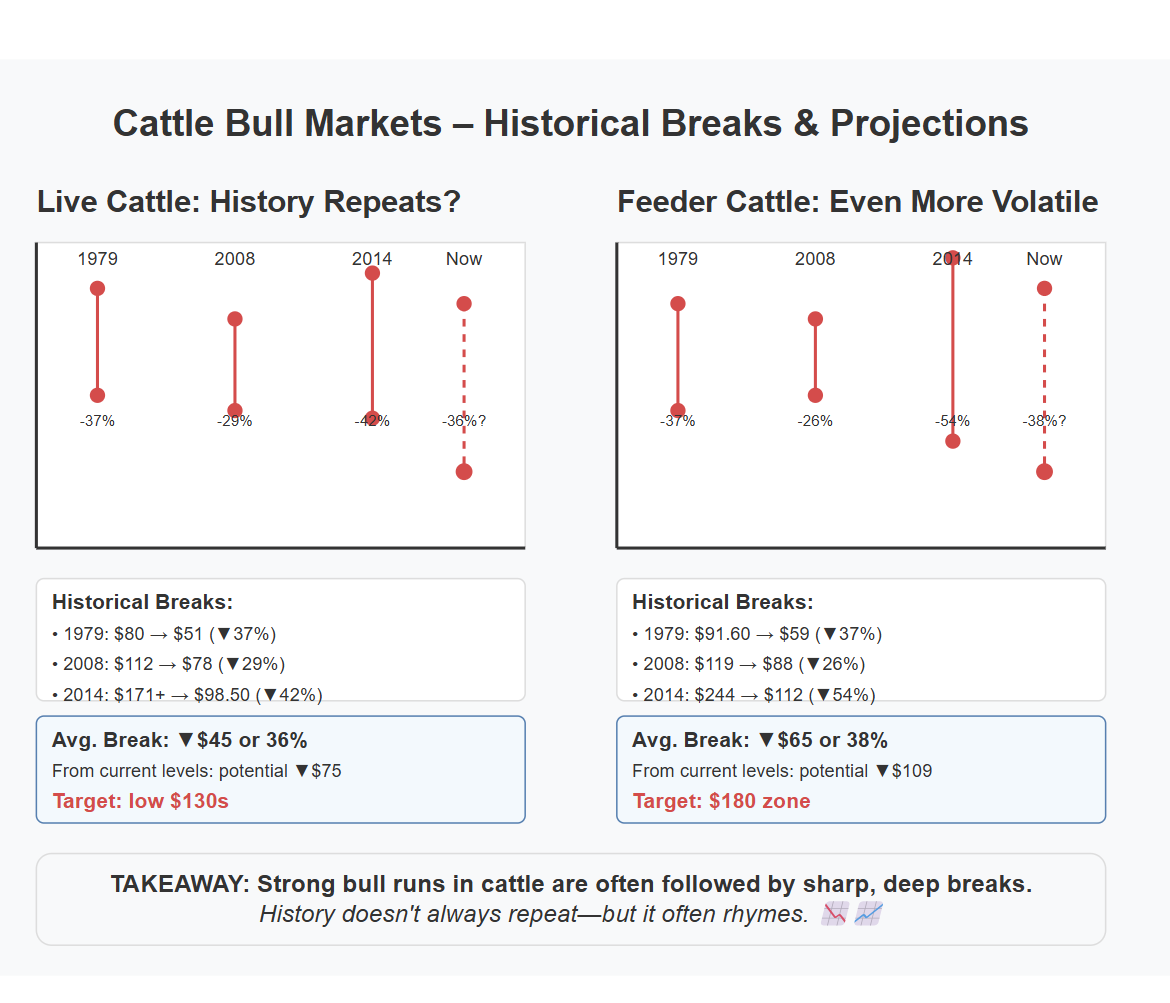
🐄 Live Cattle: History Repeats?

Top-to-bottom breaks:

  • 1979: $80 → $51 (▼37%)
  • 2008: $112 → $78 (▼29%)
  • 2014: $171+ → $98.50 (▼42%)

📊 Avg. Break:$45 or 36%
👉 From current levels, that implies a potential drop of $75, targeting the low $130s.

(opinion)

🐂 Feeder Cattle: Even More Volatile

Top-to-bottom breaks:

  • 1979: $91.60 → $59 (▼37%)
  • 2008: $119 → $88 (▼26%)
  • 2014: $244 → $112 (▼54%)

📊 Avg. Break:$65 or 38%
👉 From today’s price, that points to a $109 drop, bringing us toward the $180 zone.


Takeaway:
Strong bull runs in cattle are often followed by sharp, deep breaks. History doesn’t always repeat—but it often rhymes.

There is a substantial risk of loss in futures trading. Past performance is not indicative of future results.

Source: Bauman Commodity Consulting.
RECENT POSTS

How to Pick the Right Hedge Month for Your Cattle

TL;DR — How to Pick the Right Hedge Month for Your Cattle Match your hedge month to when cattle will likely finish, not when the board looks best today. Weather, health, and feed performance influence finish dates — build flexibility into your plan. If cattle slip or...

Cattle on Feed Report Explained for Cattle Feeders

TL;DR The USDA Cattle on Feed (COF) report drives cattle futures because it reveals real supply: placements, marketings, and on-feed inventory. What matters isn’t the number itself—but how it compares to pre-report estimates. Heavy placements → bearish. Light...

How to Trade Futures Cattle Spreads for Hedging

Futures Cattle Spreads TL;DR A cattle spread is the price difference between two futures months; some feeders trade this difference, not the outright price. Spreads move because of real cattle fundamentals — carcass weights, placements, seasonal flows, packer demand,...