
Report Summary:
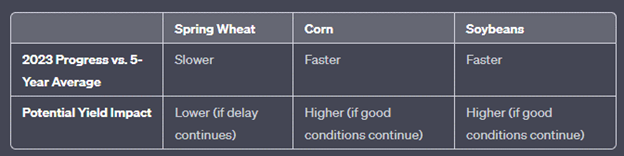
Looking at the data provided, it appears that there’s a mixed bag when it comes to planting progress for spring wheat, corn, and soybeans across the states sampled. The 2023 growing season seems to be off to a slower start than average for spring wheat, while corn and soybeans are generally progressing faster than the 2018-2022 average.
For spring wheat, with the exception of South Dakota and Washington, all states show a slower planting progress than the 5-year average. This might suggest a delay due to unfavorable weather conditions, such as cold temperatures or excessive rainfall, which could potentially delay the planting and germination of wheat.
Corn planting seems to be progressing well, with a majority of states showing a faster planting progress compared to the 5-year average. Notably, Illinois and Iowa are significantly ahead of their averages, which is a positive sign as these two states are major corn producers.
For soybeans, again, the majority of states are ahead of the 5-year average, with Illinois, Iowa, and Missouri showing particularly strong progress.
While it’s difficult to make firm yield projections based on planting progress alone, the early planting of corn and soybeans could potentially lead to higher yields, assuming good growing conditions continue. Early planting generally allows for a longer growing season and potentially higher yields. However, the slower planting of spring wheat might potentially lead to lower yields, especially if the delay continues.
It’s important to remember that the final yields will also be heavily influenced by weather conditions throughout the growing season, including temperatures and rainfall. Unfavorable weather, such as drought or excessive heat, could negatively impact yields, regardless of planting progress.
Here’s a simplified table summarizing the data:
Note: This analysis is based on the data available as of May 14, 2023, and the actual outcomes could vary depending on a range of factors, including weather conditions throughout the growing season.
Averages Comparison
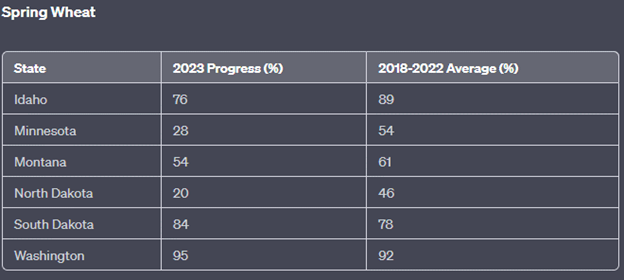
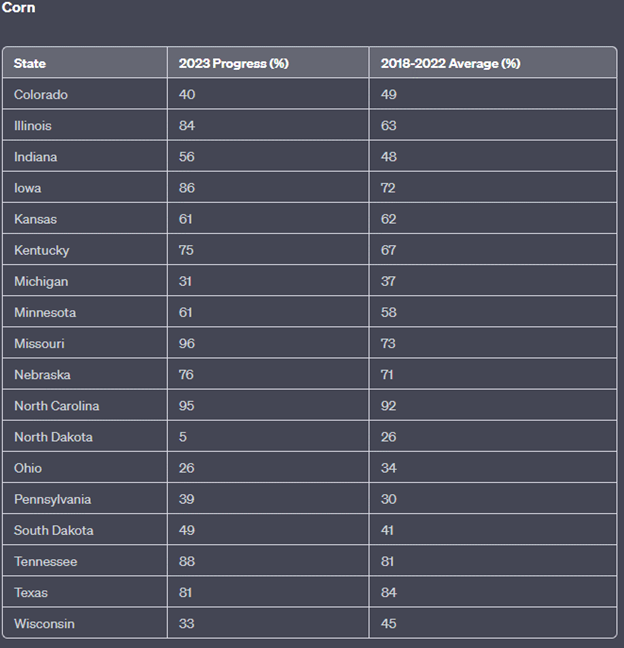
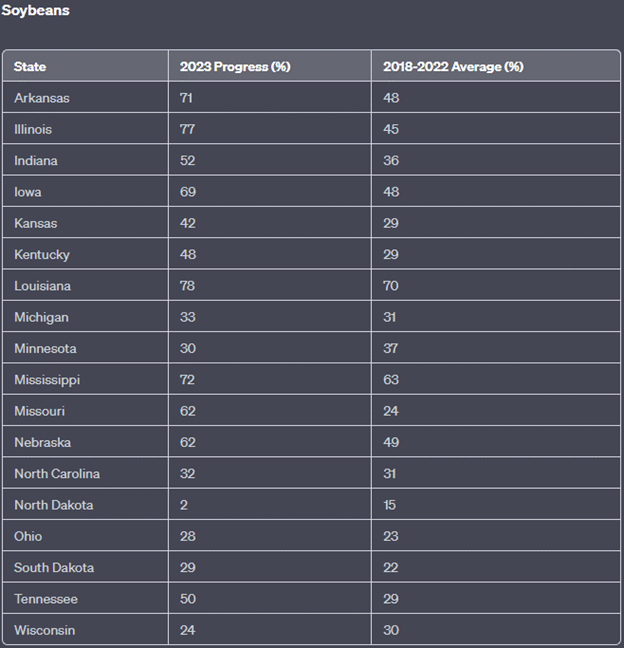
Remember, the “2023 Progress (%)” column represents the planting progress as of May 14, 2023, and the “2018-2022 Average (%)” column represents the average planting progress for the same date across the 2018-2022 seasons. The final yields will depend on a range of factors, including weather conditions throughout the growing season. The data available as of May 14, 2023, and the actual outcomes could vary depending on a range of factors, including weather conditions throughout the growing season.
Disclaimer:
The risk of loss in Commodity Interest trading is substantial. Past performance is not indicative of future results. Any content presented should be viewed as a solicitation and an inducement to conduct business with AgOptimus. Market information presented is believed to be accurate as of the time of publication. Trading and investment decisions should be made at your own risk and only with risk capital. Be advised the views and opinions expressed herein do not necessarily reflect the current views or positions of AgOptimus and are subject to change at any time.
The information contained herein has been primarily derived from the USDA Crop Progress Report, available at the following URL: https://usda.library.cornell.edu/concern/publications/8336h188j To ensure the highest level of accuracy and comprehensiveness, we strongly encourage readers to directly refer to the original report.