TL;DR
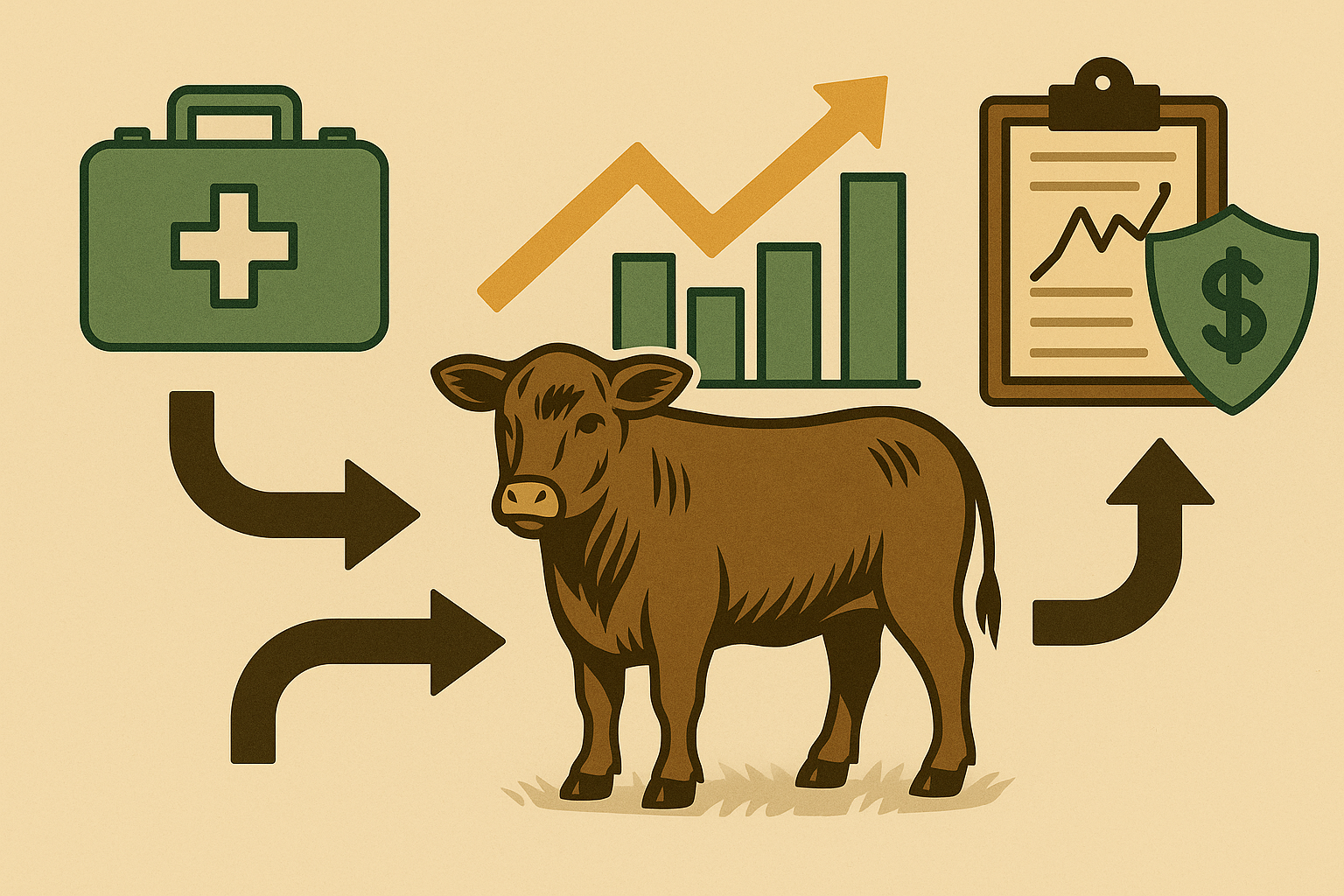
Healthy cattle create predictable performance timelines that enable hedging with futures and options. You can’t successfully hedge sick or inconsistent cattle because contracts are tied to specific months and weights. Start with good herd health protocols, document your cattle’s predictable gains, then use that predictability to help manage prices through put options (which set a price floor) or futures contracts (which lock in a price). In our view, the sequence is always: health first, predictability second, marketing third, and optional price protection fourth. Without the first step, hedging becomes gambling instead of risk management.
Introduction
Healthy cattle are predictable cattle, and predictable cattle give ranchers something volatile markets rarely do: a clearer plan. Good herd health programs—vaccination schedules, parasite control, nutrition management, and low-stress stockmanship—don’t just keep animals alive; they also help them thrive. They keep calves even, gain steadily, and market windows tight. When cattle follow the program, everything else in the business falls into place.
A rancher with a consistent herd can answer critical questions: When will these calves wean? What will my steers weigh by fall? Will this group finish together? Can I count on hitting Choice with this set? These questions aren’t just about production—they’re about timing, predictability, and planning. And those three things are at the heart of every marketing decision a rancher makes, whether selling at the local barn, direct to a backgrounder, or exploring futures and options through a commodity broker for the first time.
How Health Problems Destroy Marketing Plans
When cattle get sick, the entire marketing strategy unravels. Respiratory disease doesn’t just create vet bills—it also leads to uneven gains, pulled cattle, delayed finishing, and inconsistent frames. These problems manifest as lighter weights, lower grades, discounts, and extended feeding periods. But the bigger problem is unpredictability. Marketing becomes reactive instead of planned. You sell when you have to, not when you want to. And when the market moves against you, there’s no way to manage your downside.
This is where hedging through futures and options naturally enters the conversation—not as complex financial instruments, but as solutions to timing problems that every rancher faces. A good commodity broker understands this connection between cattle health and market timing.
Why Predictable Cattle Enable Better Marketing and Price Management
When cattle stay healthy, they gain consistently, finish in tighter weight groups, and reach target grades reliably. This creates realistic marketing windows that enable planning. If your calves consistently gain 2.3–2.5 pounds per day after weaning, your feedyard cattle finish in 150–165 days, and your cows calve within a 60-day window, you have a predictable timeline.
Predictable timelines open doors to multiple risk management tools available through commodity brokers. Forward contracts become possible because you know when cattle will be ready. Put options can help set a price floor months before cattle sell without requiring margin calls. For operations comfortable with more sophisticated strategies, selling feeder or live cattle futures can hedge expected weights against specific delivery months. The fundamental principle remains simple: You don’t hedge the cattle; you hedge the plan. And healthy cattle make that plan reliable.
Here’s why futures and options require this predictability more than cash sales: When you sell cattle at the local auction, you can adjust to whatever they weigh that day. But futures and options contracts are tied to specific months and weights. An October feeder cattle option doesn’t care that your cattle got sick and now won’t reach 850 until December. This rigid timeline is why predictable, healthy cattle are essential for successful hedging.
How to Match Your Healthy Herd to Futures and Options
When your cattle are predictable, hedging becomes straightforward math that any commodity broker can help you execute. Consider a typical scenario: You have 100 head of 550-pound calves in March, with healthy calves gaining 2.3 pounds per day on grass, planning to sell at 850 pounds in October. The October Feeder Cattle futures are trading at $245/cwt.
First, calculate your timeline. With a target weight gain of 300 pounds and daily gains of 2.3 pounds, you need approximately 130 days, putting your marketing window in late September to mid-October. This predictability only works with healthy cattle. Next, determine your contract coverage. Your 100 heads at 850 pounds equals 85,000 total pounds. Since each feeder cattle contract covers 50,000 pounds, you need 1.7 contracts—so you’ll use either one contract for partial coverage or two for full coverage.
For most ranchers working with commodity brokers, put options make the most sense. Buying two October $245 puts in April might cost $3.50/cwt in premium, or $1,750 per contract. Your $3,500 premium helps set a price floor. If the October market drops to $225, you collect $20/cwt. If it rises to $265, you sell at the higher price and only lose the premium—essentially the cost of the floor. This strategy requires no margin calls, making it accessible to operations of any size.
Timing Your Hedges Around Herd Health Calendars
The best time to place hedges follows your herd health calendar, not market speculation. For cow-calf producers, assess cow condition pre-breeding for calving predictability. Once calves are healthy at 30-60 days old, project fall weights. Three to four months before weaning, explore October or November feeder cattle options, then adjust at weaning based on actual weights.
Backgrounders should know break-evens at purchase, then wait until cattle are settled and healthy after 30 days. Place protection 60-90 days before your sale date, adjusting monthly based on actual gains. Smart producers review positions as cattle perform, ensuring hedges match production.
Feedyard operators typically hedge at placement based on projected finish dates. After 30 days, when health and performance patterns emerge, they adjust positions. At 60 days out, coverage gets fine-tuned based on actual performance. Thirty days before harvest, many establish basis contracts with packers while maintaining futures positions.
Understanding Feeder Cattle Options and Futures Pricing
Put options work like a price floor for your cattle. When you buy a put with a $245 strike price and pay $3.50 in premium, your floor price becomes $241.50. If the market drops below your strike price, your floor helps offset the lower cash price. If the market rises above your strike plus premium, you capture the full upside minus your premium cost. This makes Puts well-suited to ranchers who want a floor without sacrificing opportunity or dealing with margin calls.
Futures contracts require more sophistication but offer precise hedging. Selling futures locks in a price, eliminates upside potential, and requires margin maintenance. Initial margin typically runs 5-10% of contract value—about $6,000-12,000 for a feeder cattle contract worth $122,500. You must maintain approximately 75% of the initial margin and add money if the market moves against you. This is why many producers recommend starting with options before advancing to futures.
Understanding basis—the difference between your local cash price and futures—is critical for accurate hedging. Your net price equals the futures price plus the basis. If futures are $245 and your typical basis is negative $3, your expected cash price is $242. Healthy, uniform cattle consistently command better basis than inconsistent groups, another reason herd health matters for marketing.
Ranchers Helping Ranchers Manage Price Risk
Our broker Nate says cattle don’t lie… but they sure don’t cooperate either
When your cattle are healthy and moving along, it’s a good time to look at the marketing side. Futures and options are tools some ranchers use to manage price swings, and we can help you understand how they work.
At Ag Optimus, our brokers ranch too — so the conversation stays practical, straightforward, and grounded in real-world cattle work.
If you want information, not pressure, we’re here to visit.
📞 (800) 944-3850 | (712) 545-0182
🌐 www.agoptimus.com
Real-World Application: From Health Records to Hedge Positions
Consider how this works in practice. A cow-calf operation with excellent herd health knows its April-born calves will reach 850 pounds by October. In May, they buy October put options to help manage the risk of price declines while maintaining upside potential. They choose appropriate strike prices based on break-even costs and risk tolerance. If disease strikes and gains slow, those October options become problematic—the cattle won’t be ready, and the hedge fails.
A backgrounding operation buying 600-pound stockers with consistent health programs knows these cattle will reach 850 pounds in five months. They establish either put options or a short futures position, depending on risk tolerance and margin capacity. With 30 head at 850 pounds—25,500 total pounds—they might use partial coverage rather than a full 50,000-pound contract.
Feedyard operators with strong receiving protocols and minimal death loss can accurately project finish dates and weights. Two hundred head entering at 750 pounds in November, gaining 3.5 pounds daily, will reach 1,350 pounds in April. They hedge with six or seven live cattle contracts, each covering 40,000 pounds, monitoring positions daily for margin calls or adjustment opportunities.
Common Mistakes in Cattle Hedging
The biggest hedging mistake, in our opinion, is trying to hedge unpredictable cattle. Sick or inconsistent cattle throw off timelines, making accurate hedging impossible. Only hedge healthy, performing cattle with predictable outcomes. Over-hedging—covering more pounds than you’ll produce—stems from optimistic projections. Base coverage on conservative estimates backed by health history, typically hedging 70-80% of expected production.
Timing errors occur when ranchers try to outsmart the market rather than following their production schedule. Focus on your cattle’s timeline, not market predictions. Using the wrong contract month results in costly delivery mismatches. Ensure contract months align with your actual marketing timeline, building in buffer time for health or weather delays.
Building Your Hedging Program Around Herd Health
Start by documenting your herd health performance over multiple years. Track average daily gains by season, death loss percentages, and treatment rates. This data becomes the foundation for predictable marketing windows that enable effective hedging through futures and options.
Work with your veterinarian to establish consistent health protocols that minimize variability. Vaccination timing, parasite control, and nutrition programs should focus on predictable performance rather than just survival. Share this health data when exploring hedging strategies—it helps determine appropriate coverage levels.
Consider starting with simple strategies. Put options for price floor coverage require no margin calls and preserve upside potential. As you gain experience, you might advance to futures contracts or more complex option strategies. But always remember: the hedge supports the plan, and the plan depends on healthy cattle.
Frequently Asked Questions
How many feeder cattle do I need to start hedging?
You can hedge any number of feeder cattle—while standard contracts cover 50,000 pounds, put options allow partial coverage. Many ranchers start by covering just 25-50% of their production to gain experience.
What’s the minimum investment to start hedging cattle?
For options, you need premium money upfront—typically $2-5 per hundredweight, so covering 50 head might cost $850-2,125. Futures require margin accounts of $4,000-$8,000 per contract, plus maintenance margin.
When should I place my first hedge?
Place hedges 3-6 months before marketing, but only after cattle are healthy and gaining predictably. Spring calves selling in October would hedge in April-May; feedyard cattle hedge within 30 days of placement once health is established.
What if I’ve never used futures markets before?
Start with put options—they’re simpler than futures and set a price floor with no margin calls. Many successful cattle producers have never traded futures but use options regularly for downside coverage.
How do I learn more about cattle hedging strategies?
Educational resources include CME Group’s livestock education materials, university extension programs on risk management, and commodity brokers who specialize in livestock.